
Elected representatives dream of restoring the old line all the way to Porto-Vecchio. But yesterday’s working meeting with mayors in Vescovato revealed the scale of the difficulties in linking Casamozza to Folelli.

Six years: roughly the journey time by train between Casamozza and Folelli. That may sound rather slow, but bringing the eastern plain railway revival safely to its destination — or platform — is an obstacle course, more technical and legal than political.
Yesterday, the project entrusted to consultancy Systra was presented in detail at Vescovato town hall to all the mayors concerned: the host village, Venzolasca, Monte, Sorbo-Ocagnano, Tagliu-Isulacciu, Castellare and Penta-di-Casinca.
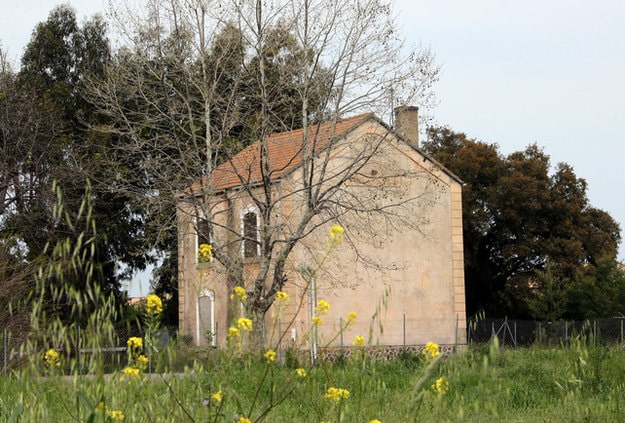
An old Casinca station, preparing, like so many others, for a new lease of life…
Several executive councillors, led by their chief ‘stationmaster’, and territorial councillors attended a presentation and discussion that ultimately produced two main conclusions.
First, consensus. Almost everyone welcomes the train crossing their territory for a carriageful of good reasons: time savings, safer journeys, less pollution and lighter road traffic, and above all a boost to the local economy.
Then, doubt: the project is strewn with so many obstacles that they could provide ballast for the future tracks.
Following the historical route is impossible
Hyacinthe Vanni is smiling. The railway he chairs is financially healthy, and passenger numbers keep growing, from 700 000 to 1,1 million in five years.
That gives momentum to this priority project, whose ultimate goal is to reach Porto-Vecchio, as in the old days. Vanina Borromei describes it as ‘an essential step’.
Gilles Simeoni joins the discussion and reminds the mayors that the project is included in the Padduc development plan.
‘The train is returning to the heart of our strategic vision for territorial development. This is exactly the kind of project that can succeed only if we work together, and that is the approach we want to promote for major infrastructure schemes.’
A route with variations…
- Route length: 10.390 metres along the historical alignment, with a few additional kilometres depending on the options chosen.
- Estimated cost: from 42 million (32 million for construction and 10 million for land) to 48 million, depending on the final routes.
- Construction time: approximately six years.
The investment will exceed 42 million euros.

At Vescovato town hall, members of the governing majority, mayors and technical staff closely examined plans to revive the railway between Casamozza and Folelli, with a view to extending further along the eastern plain.
PHOTOGRAPHS: JACQUES PAOLI
‘It can be funded, but it is not funded, and we will have to make budget choices,’ concludes the president of a Collectivité de Corse that can no longer afford lavish spending. He hopes the project will be eligible under the future post-PEI programme.
On paper, the route extends just over ten kilometres, following the historical alignment before the track was dismantled in 1953.
There is a problem, however. Since then, the communes have grown, houses and businesses have sprung up, and roads have been built. Except in a few places, simply following the original route is impossible.
For river crossings, though, it is better to retain the old route rather than encounter stricter new regulations that would be almost insurmountable.
Another major challenge is placing new stations as close as possible to the centres of the communes served, making access easier for residents and attracting people and businesses.
The ‘tram-train’ option will be favoured
In principle, the project’s technical staff, led by the Collectivité de Corse’s transport director Benoît Montini, favour the shortest, most direct route possible. The mayors themselves fully understand what is at stake and are generally cooperative.
Yannick Castelli, mayor of Penta, is among them: like Marie-Thérèse Mariotti, mayor of Taglio, he clearly prefers the train to the new road project.
Folelli, with 3 300 inhabitants today compared with 30 when trains ran there, will house the terminus until further extension. It is set to become a strategic town for the whole region: Casinca, Costa Verde and Castagniccia.
Each mayor was offered a variation on the historical alignment. The closer the route gets to built-up areas, the more useful and beneficial it becomes — but also the more complicated and expensive.
This led to discussion of rolling stock and the purchase of a ‘tram-train’: a train able to run at a good speed in open countryside and slow down through town centres with as little disruption as possible.

Following the historical route will be no easy task. It will be possible only in a few places; elsewhere, extensive development has taken place since the tracks were dismantled 65 years ago…
The discussions revealed the full scale of the technical and legal difficulties: keeping a sufficient distance from homes, relocating utilities, integrating the project into planning documents being drafted or revised, considering some compulsory purchases, and accounting for numerous safeguards — agricultural land, which occupies much of the route, coastal law, flood zones and more.
Some participants, including those from Castellare-di-Casinca, showed frustration at so many obstacles to construction, even if the railway itself was hardly to blame.
A Herculean task still lies ahead between Casamozza and Folelli.
‘This project has a long history,’ says Gilles Simeoni.
It will happen, but it is not about to arrive. Even if everyone agrees on the need to get moving.
A reminder…
The first section of the eastern plain railway opened in 1888, between Bastia and Ghisonaccia.
It was extended to Porto-Vecchio in 1935.
Along its 152 km, several stone and metal bridges were built, and even a 500 m tunnel.
In September 1943, retreating German troops destroyed tracks and bridges; eighteen bridges were blown up.
In 1958, a large part of the property portfolio, particularly crossing keepers’ houses, was put up for sale.
Reopening the eastern plain railway became a science-fiction project.
In 1982, during Giacobbi’s term, the principle of commissioning studies was agreed.
The current majority dreams of reaching Porto-Vecchio, but must first consider getting to Folelli in 2024.
Source: Corse Matin