
An island. Rails. A story.
Before the first trains came ideas, decisions and construction sites. Explore the history of Corsica’s railway, one year at a time.
Before Corsica’s railway, a Sardinian–Corsican dream.
Receiver-General Conti imagines an extensive route combining sea travel and railways across Corsica and Sardinia. The aim goes far beyond serving the island itself: Corsica is to become a stage on a major connection between European Mediterranean ports and North Africa.
From Marseille, Genoa or Livorno, travellers would reach Corsica by sea, cross the island by rail, then continue through Sardinia before reaching Bône, in Algeria. According to the proposal, this combination of rail and sea travel would reduce the total journey time from around 50 to 35 hours.
At this stage, it is still only a vision: no railway exists in Corsica, and these journey times are estimates. Yet Conti’s proposal already introduces an idea that will shape early thinking about the island’s railways: using Corsica’s position at the heart of the Mediterranean to make it a link between Europe and North Africa.
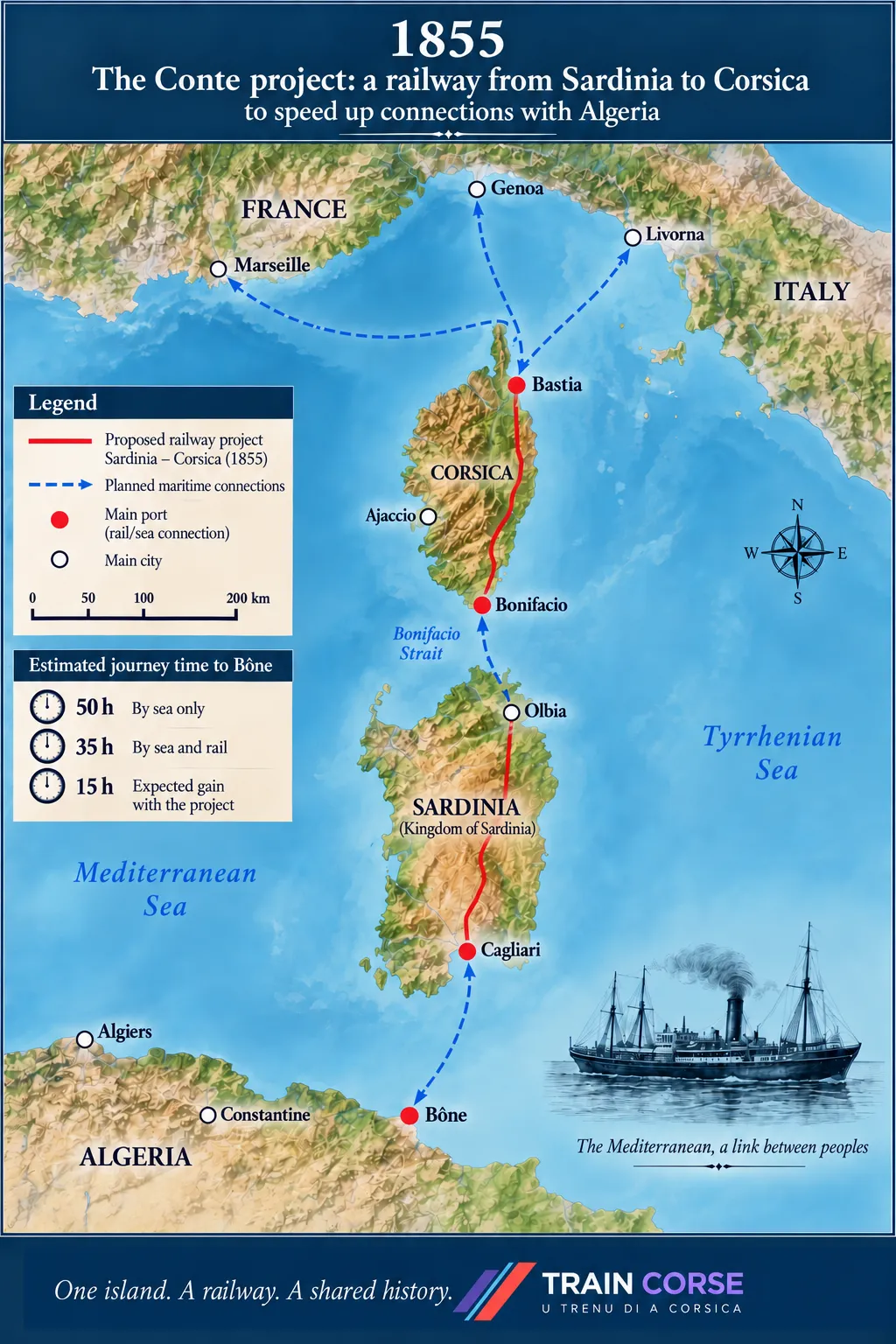
Conti’s Sardinian–Corsican connection proposal in 1855.
From Conti’s idea to Tourneux’s studies
Six years after Conti’s proposal, Chief Engineer Tourneux takes up the idea of a Sardinian–Corsican railway. The project retains its Mediterranean dimension: the aim is not yet simply to connect the island’s main towns, but to integrate Corsica into a route combining railways and sea links.
The island’s geographical position remains central to the reasoning. Corsica is envisaged as a link between Europe, Sardinia and North Africa, with the railway making it possible to cross the island more quickly.
This revival marks an important stage: the idea put forward by Conti in 1855 does not disappear with his first proposal. It enters a new phase of study and prepares the ground for discussions that, over the following years, will gradually shift the priority towards Corsica’s own needs.

From Conti to Tourneux: early studies for the Sardinian–Corsican railway.
Priority shifts inland.
Bastia–Ajaccio gradually gained precedence over Bastia–Bonifacio. But the debate remained open. That same year, Antoine Fabiani published a 163-page study in Bastia in which Bastia–Bonifacio remained the main axis of a network conceived on a Mediterranean scale. Combined with Sardinian railways and sea links, it was intended to encourage trade with Sardinia, Italy and North Africa.
Fabiani also examined a connection to Ajaccio along three possible routes: via Sartène, via the Tavignano valley, or via the Golo valley through Ponte-Leccia and Corte, with Vizzavona as the major obstacle. In the following years, advances in shipping, Italian unification and changes to customs arrangements would diminish the appeal of this international ambition and strengthen the priority given to the island’s domestic needs.

Antoine Fabiani’s railway proposal of 1864.
Antoine Fabiani · Les chemins de fer de la Corse, 1864 · Médiathèque Culturelle de la Corse · COTE BU17 FAB 61014
How to cross Vizzavona?
In February, the ministry called for the studies to be resumed. The pass, at 1,161 metres, was the main obstacle. The Fell system, with a proposed gauge of 1.10 m, was among the solutions considered. Two routes through Corte were examined: one via the Golo valley, Corte and Vizzavona, following the national road corridor; the other reaching Corte from Aléria through the Tavignano valley. A third, much longer route via Porto-Vecchio and Sartène was also compared.

How the Fell central-rail system works.
Comparing distances and costs.
The report of 16 August recommends the direct route, using the Fell system on gradients. The engineers continue studying variants the following year, setting aside the detour via Sartène. These comparisons show how strongly the terrain shapes the project.
Bastia–Ajaccio variants studied in 1869
| Route | Conventional adhesion | Fell system |
|---|---|---|
| Golo · Corte · Vizzavona | 156 km · 41 658 000 F | 152.8 km · 23 650 000 F |
| Aléria · Corte · Vizzavona | 177.8 km · 41 439 000 F | 169.8 km · 26 000 000 F |
| Porto-Vecchio · Sartène | 275.2 km · 50 191 500 F | Not included in the table |
Distances and estimates in francs of the period; no conversion into euros.
Private concession bids come to nothing.
In the early 1870s, the construction of a railway in Corsica attracts several private initiatives, but none comes to fruition. On 7 August 1873, British investors request access to the file to study the proposal. Their approach leads no further.
On 20 September 1874, Cotard and Champouillon submit their own application for a concession. Their proposal is ambitious: a main line would connect Bastia to Bonifacio, with branches from Aléria to Corte and from Bonifacio to Ajaccio. To make construction less costly in Corsica’s mountainous terrain, the ministry considers metre gauge, with gradients limited to 25 ‰.
Cotard and Champouillon seek further cost reductions. On 27 August 1875, they propose new specifications allowing gradients of up to 30 ‰ and curves with a minimum radius of 80 metres. In Bastia, they also want to move the station between Saint-Joseph and the cemetery, avoiding the costly excavation of the Torretta tunnel.
The two entrepreneurs establish a joint-stock company to build the Corsican railways, but ultimately withdraw after failing to obtain the declaration of public utility required for their project.
A final attempt comes on 7 April 1876, when Baron d’Ornano applies for a concession for a Bastia–Ajaccio line. This too comes to nothing.
After several years of private proposals, no concession has therefore been granted. This succession of failures precedes a decisive change: from 1877, the State itself defines the technical specifications of the future network.
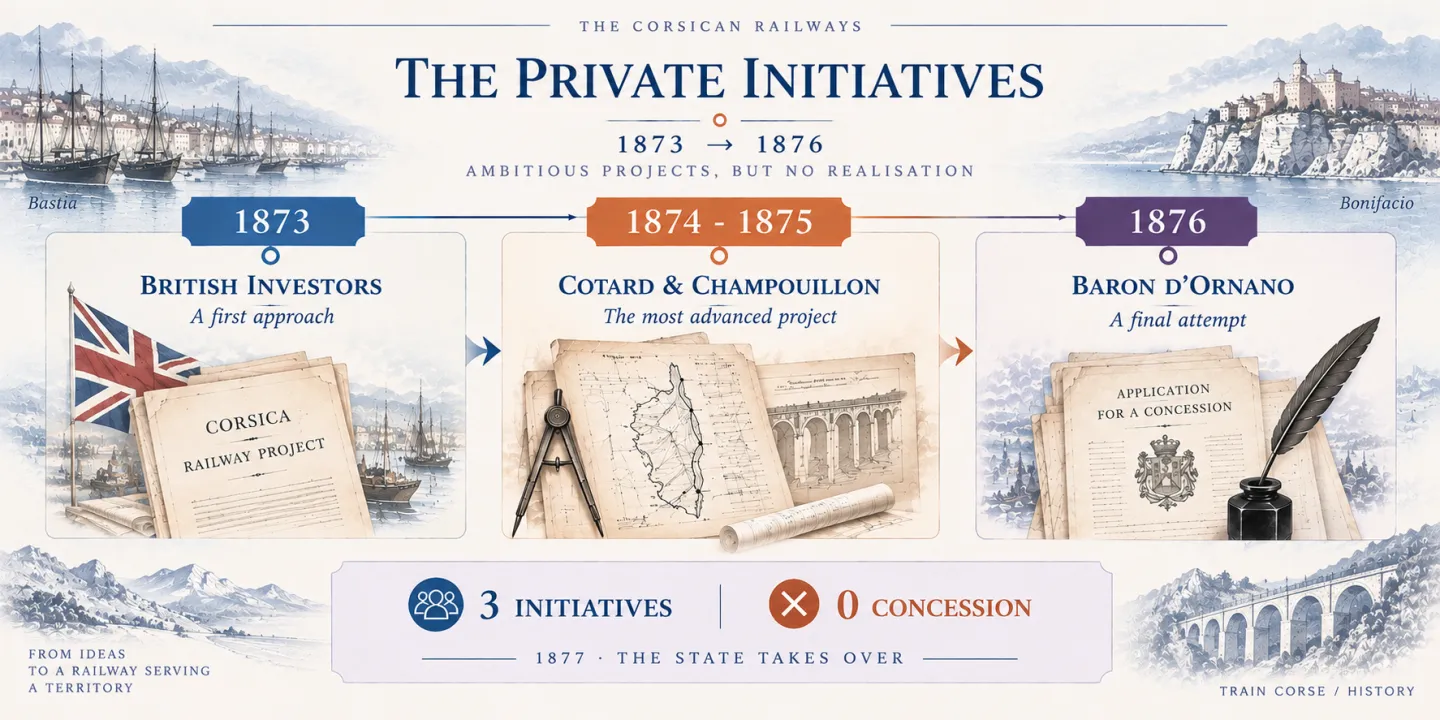
Private attempts to build the network from 1873 to 1876.
One metre between the rails.
The ministerial decision of 3 May established the fundamental characteristics of Corsica’s future network: it would use metre gauge and Vignole rails weighing 20 kg per metre. Gradients were initially limited to 20‰ on Bastia–Ajaccio and 25‰ on the other proposed lines. On 15 August, the prefect was invited to continue the studies on this new basis. The choice of metre gauge, which still characterises Corsica’s network today, had now been settled.

Maximum gradients planned for the future Corsican network: 20 ‰ on the main Ajaccio–Bastia line and 25 ‰ on the other proposed lines. Annales des Ponts et Chaussées, 1884 · Source: gallica.bnf.fr / École nationale des ponts et chaussées.
The project enters legislation.
On 28 March, Charles de Freycinet presented the government’s bill for the railway from Ajaccio to Bastia via Corte. The entire line was then estimated at around 159 kilometres and 25 million francs. The bill provided for work to begin immediately on the Ajaccio–Ucciani and Bastia–Corte sections, while studies continued on the intervening section.
Passed by the Chamber on 6 June and then by the Senate on 8 June, it became the law of 17 June 1878, which declared the railways from Ajaccio to Mezzana and from Bastia to Corte via the Golo valley to be of public utility. It also ordered the completion of studies for the intervening Corte–Mezzana section, authorised the Minister of Public Works to begin construction and allocated an initial credit of 500,000 francs for the work.
On 7 December, a symbolic blessing marked the first works; actual construction began later.

Legislative milestones for Corsica’s railway in 1878.
Alfred Picard · Les chemins de fer français, t. III, 1884 et Bulletin des lois de la République française · n° 415 · loi n° 7417 du 17 juin 1878 · p. 605–606 · BnF/Gallica
A much larger network takes shape
On 17 July, the major classification law of the Freycinet programme listed three new Corsican lines among the 181 railways incorporated into the network of general interest: Ajaccio–Propriano, Ponte-Leccia–Calvi and Casamozza–Bonifacio. The law required completion of the studies and administrative procedures needed for their declaration of public utility.
Corsica’s future network was no longer confined to the Ajaccio–Bastia axis: its extension towards Balagne, the south of the island and Propriano was officially included in the national railway programme. On 27 December, a new law declared the Mezzana–Corte section to be of public utility and authorised the Minister of Public Works to begin construction.
This decision supplemented the 1878 declarations of public utility for Ajaccio–Mezzana and Bastia–Corte: the entire Ajaccio–Bastia route via Corte now had the legal framework needed for its construction.
The network takes shape
The proposed network: 433 km · 57 million francs
| Proposed line | Distance | Estimate |
|---|---|---|
| Bastia · Corte · Ajaccio | 156 km | 25 000 000 F |
| Ajaccio · Propriano | 55 km | 6 000 000 F |
| Ponte-Leccia · Calvi | 72 km | 11 000 000 F |
| Casamozza · Bonifacio | 150 km | 15 000 000 F |
Project estimates. The 433 km do not represent the length of the network actually built.
Inclusion in the general-interest network
- Ajaccio → Propriano
- Ponte-Leccia → Calvi
- Casamozza → Bonifacio
Declaration of public utility
- Mezzana → Corte
Bulletin des lois de la République française, XIIe série, tome XIX, 1879 — loi n° 8168 du 17 juillet 1879 et loi n° 8724 du 27 décembre 1879. Source : Gallica / Bibliothèque nationale de France.
The major tunnelling works begin.
After years of studies and administrative decisions, work finally began on the ground. In February, boring started on the Torretta tunnel in Bastia and the Aspretto tunnel in Ajaccio. The Aspretto tunnel, initially planned to be approximately 247 metres long, was bored during the year; its length was subsequently extended to 376 metres.
These major works also proved particularly dangerous. In August, at the Torretta tunnel, blasting caused a sudden inrush of water: seven workers drowned. At Aspretto, a collapse also killed five Italian workers, while others were seriously injured during blasting operations. At Vizzavona, exploratory drilling began in spring.
To avoid taking the railway over the pass, which rises to 1,161 metres, the Ponts et Chaussées decided to cross the mountain through a tunnel whose northern entrance lay at around 906 metres above sea level.
At 3,916 metres long, it was the central line’s principal construction project. Chief engineer Dubois studied the methods used for the great Alpine tunnel works and recommended two mechanical drills. Boring began in early summer: a pilot gallery around two metres in diameter was driven from both ends, assisted by four vertical shafts. It would subsequently be widened to the tunnel’s final dimensions and lined with masonry, before the formation was ballasted and the track laid.

The Aspretto tunnel construction site in 1880. Collection Jean Melero.
In Balagne, choosing the sea.
The proposal submitted on 6 November compares two routes after a shared 28 km stretch between Ponte-Leccia and Palasca. The first serves more villages, including Aregno, with Île-Rousse on a branch. The second passes through Île-Rousse and then follows the coast to Calvi. It is 4 km shorter and almost half as expensive, and is the option chosen.
That same year, several technical choices for the network were clarified. On 8 June, metre gauge was definitively defined as one metre between the inner faces of the rails. On Vizzavona’s steep climbs, gradients of 30‰ were to be interrupted at regular intervals by less steep sections. The engineers also planned to use double-heading to negotiate them.
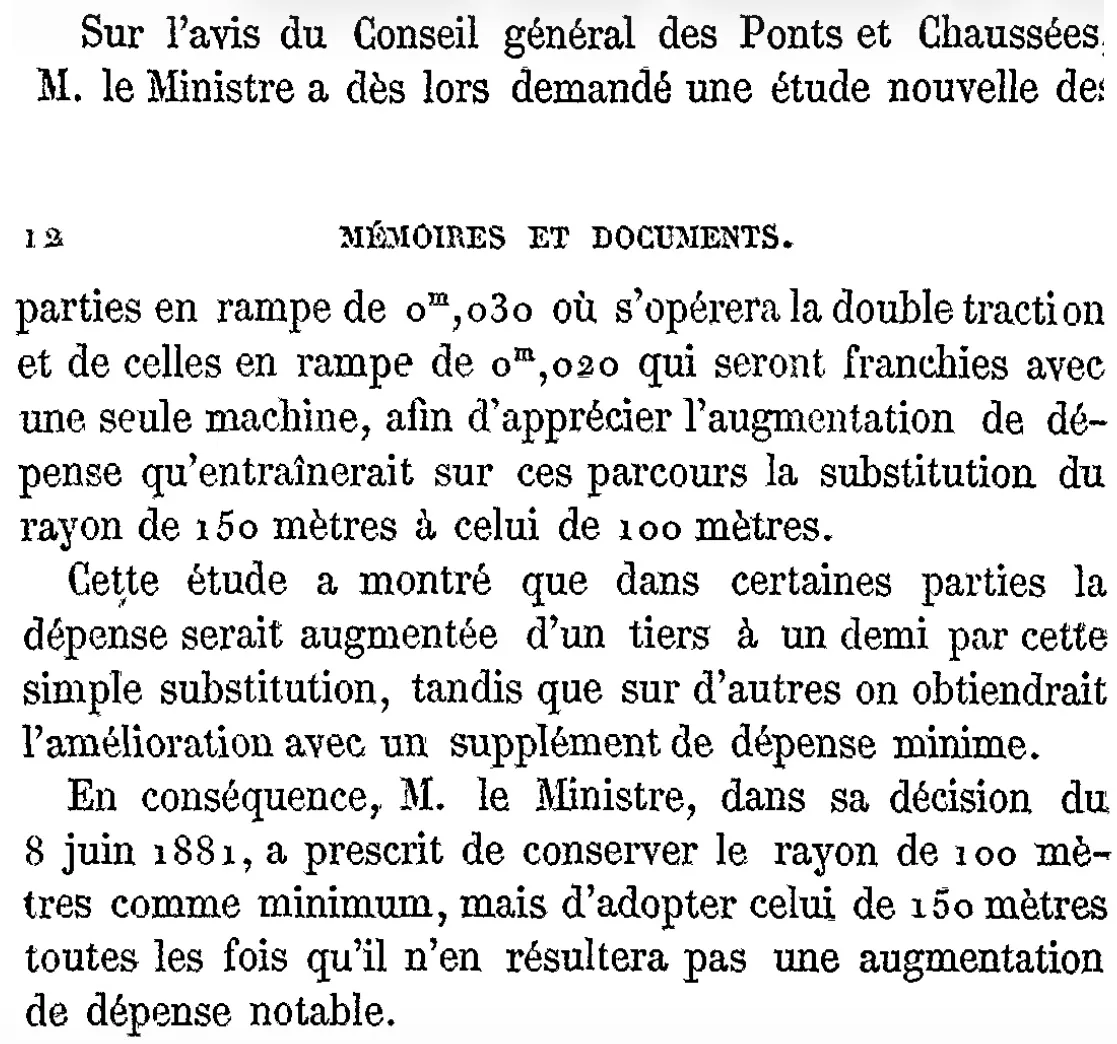
Steep gradients and curves on the future network: the decision of 8 June 1881 retains a minimum radius of 100 m and provides for double heading on 30 ‰ gradients. Annales des Ponts et Chaussées, 1884 · Source: gallica.bnf.fr / École nationale des ponts et chaussées.
Water halts work at Vizzavona.
On 3 September 1882, after two years of boring, a major inrush of water occurred around 1,700 metres from the tunnel’s northern entrance. With an estimated flow of 60 to 70 m³/h, it flooded more than 600 metres of gallery and drowned three workers. To avoid lengthy pumping work, boring resumed from the southern entrance, where the gradient allowed water to drain towards the Gravona. The works took a heavy human toll: between 1881 and 1883, collapses also killed four workers and seriously injured twelve. Several more years would be needed to complete the tunnel.
The CFD take their place.
The agreement signed on 21 February 1883 and approved by the law of 19 December entrusts the Compagnie de chemins de fer départementaux with building Ponte-Leccia–Calvi and Casamozza–Fium'Orbo, as well as equipping and operating them. The company is also to operate Bastia–Ajaccio, whose construction remains under State direction. The agreement runs for fifteen years, renewable thereafter for periods of three years.
Meanwhile, engineers define the rolling stock for the future network. Because of the line’s tight curves, a report dated 15 April recommends passenger coaches with articulated running gear. Two layouts are studied: coaches with conventional compartments and coaches with a central aisle.
Depending on the layouts under consideration, these coaches are to provide up to 56 seats, include luggage space and offer several configurations suited to the distribution of classes and the passenger demand expected in Corsica.
These technical studies continue in the following years to establish the characteristics of locomotives, coaches and wagons suited to the future metre-gauge network.
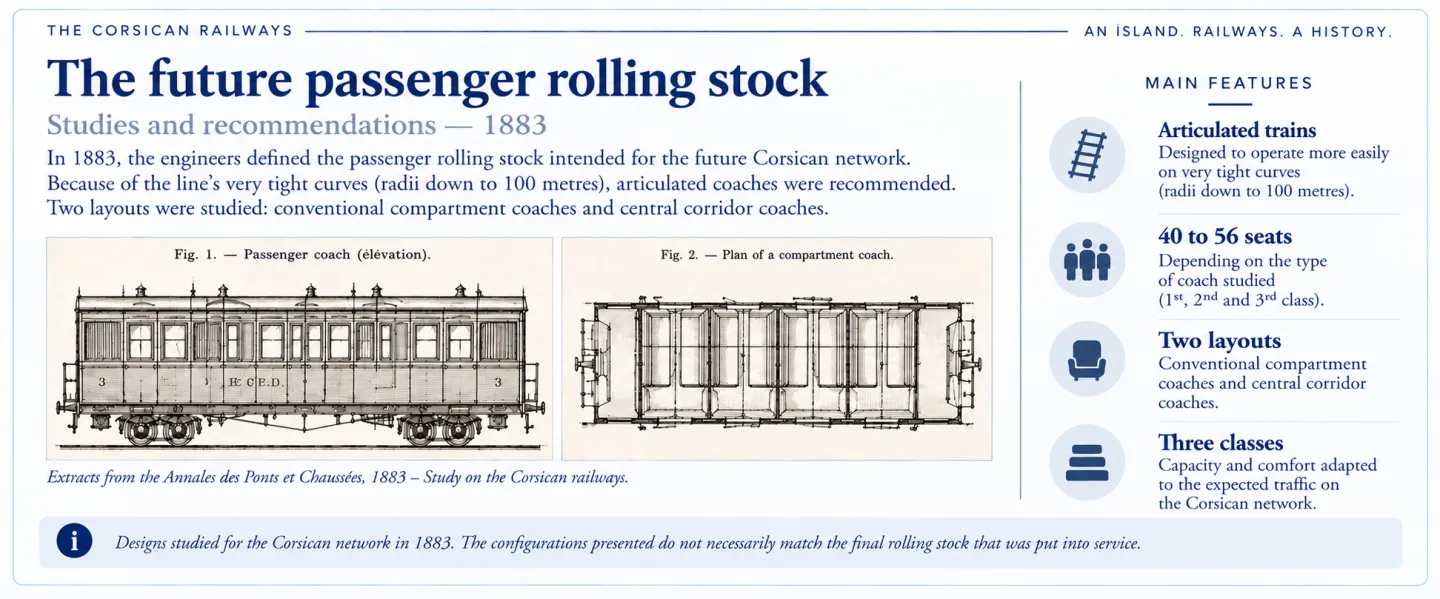
Studies for Corsican passenger coaches in 1883, with up to 56 seats.
Two construction sites, two challenges.
Work begins on the Balagne and east coast lines. In the east, three construction locomotives support rapid progress towards Tallone. In Balagne, the difficult terrain requires several changes to the alignment as construction advances towards Palasca.
At the same time, the rolling stock for the future network takes shape. Studies adapting traction to metre gauge, tight curves and steep gradients lead Sartiaux and Bandérali to select a tank locomotive with three coupled axles and a trailing Bissel truck as their design for study. They consider it particularly well suited to the Corsican railways then under construction.
Meanwhile, the CFD choose Fives-Lille 031 T steam locomotives for operation; the first are delivered from 1886 onwards.

Tank locomotive with three coupled axles and a trailing Bissel truck, studied for the Corsican railways. Sartiaux and Bandérali subsequently develop this locomotive type further and select it as particularly suited to the constraints of the future network. Annales des Ponts et Chaussées, 1884, 6e série, planche 3.
The first passenger trains.
On 1 February, the first commercial trains ran between Bastia and Corte and between Casamozza and Tallone. On 17 June, the east coast line was extended to Ghisonaccia. In the south, the line from Ajaccio reached Bocognano in December. Corsica’s railway thus genuinely entered regular operation, with its steam locomotives and first passenger carriages. But the network remained fragmented: the central crossing was unfinished and Bastia still had no direct connection to Ajaccio.
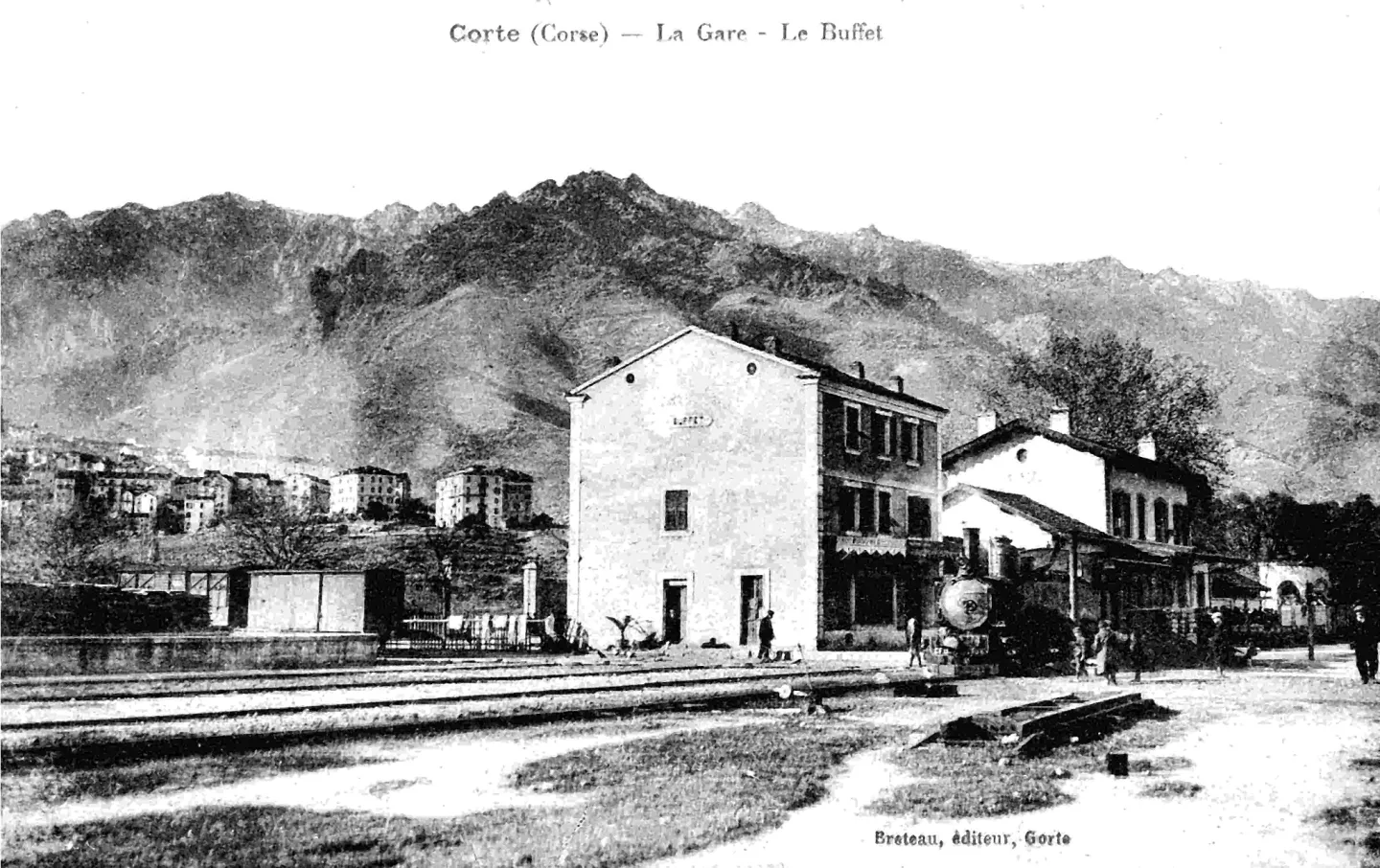
Corte station and a steam train. Collection Luc Beaumadier – traincorse.free.fr.
Palasca and Vizzavona are reached.
On 10 January, the Balagne line opened from Ponte-Leccia to Palasca. The railway now served Pietralba, Novella and Palasca, while Ponte-Leccia consolidated its role as the junction between the central line and the future connection to Calvi. But construction in Balagne encountered difficult ground. During the winter of 1888–1889, the roof of the Conculi gallery, between Novella and Palasca, collapsed and blocked the track. Rather than rebuild it identically, a new alignment was chosen, with a tunnel driven deeper into the mountain. A temporary diversion allowed trains to pass at walking pace while work continued.
This incident contributed to the delay in opening the next section to Calvi, which would not take place until November 1890. On 14 July, another major milestone was reached on the central line: trains from Ajaccio reached Vizzavona. Beyond Bocognano, opened the previous year, the track now climbed the upper Gravona valley and crossed the mountain range through the great Vizzavona tunnel, 3,916 metres long. However, the central line remained split in two: Bastia was connected to Corte, while Ajaccio was now connected to Vizzavona. Between Corte and Vizzavona lay the most difficult part of the route, via Vivario and the Vecchio valley.

Collection Luc Beaumadier · traincorse.free.fr
Balagne reaches Calvi as the Vecchio project takes shape
On 15 November, the Palasca–Calvi section opens to traffic. The Balagne line is now complete over its 73.2 kilometres from Ponte-Leccia. Beyond Palasca, the track descends towards Belgodère and the Regino, reaches L'Île-Rousse, then follows the coast through Algajola and Calenzana-Lumio before arriving in Calvi. This opening completes the route chosen in 1882, passing through L'Île-Rousse and following the coast to Calvi. The Corsican network's second major line is thus finished.
A few days earlier, on 10 November, four 130T locomotives built by Fives-Lille, numbered 53 to 56, are delivered to Corsica to operate the Balagne line. Two are allocated to Calvi and two to Ponte-Leccia. They gradually enter service between late November and mid-December and become characteristic of steam operations on the line.
Meanwhile, on the central line, preparations are under way for one of the network's most spectacular structures. In 1890, the Minister of Public Works approves a design for a metal viaduct to cross the deep Vecchio gorge between Venaco and Vivario. The structure will allow construction to continue on the last missing link between Corte and Vizzavona. The future viaduct is designed with three metal spans resting on two tall masonry piers. Its deck will measure around 140 metres, with an overall length of around 171 metres.
Work enters its decisive phase the following year. In 1891, separate contracts are put out to tender for the masonry and the metal deck. On 16 May, Gustave Eiffel wins the contract to supply and install the metal deck, offering a 33% discount on an estimated cost of 200,000 francs. Construction of the viaduct can now truly take shape.
The opening of Calvi and the start of work on the Vecchio mark two major advances: the network's second major line is complete, while in the heart of the island the structure is taking shape that will, a few years later, remove one of the last obstacles to the Bastia–Ajaccio connection.
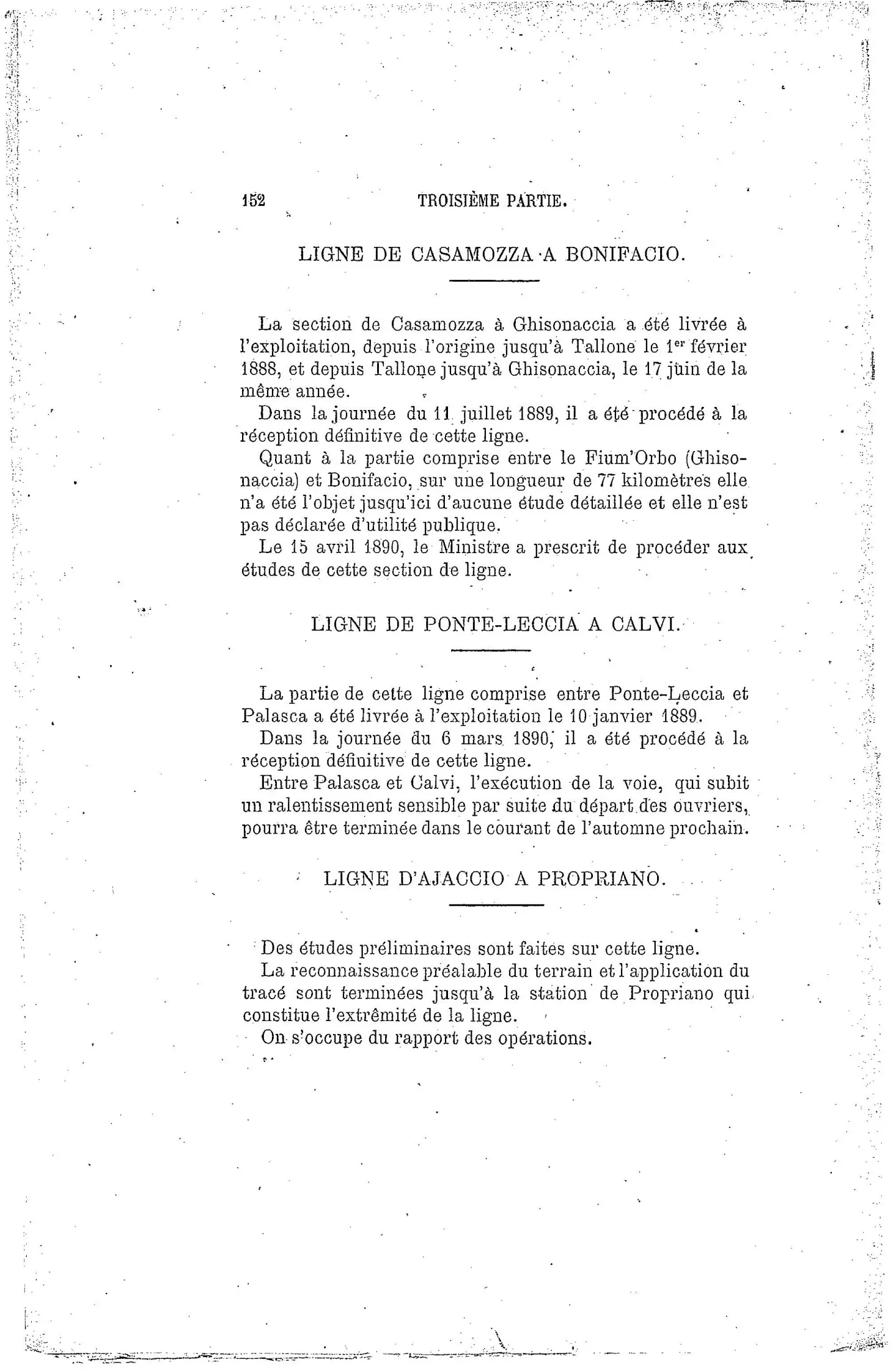
Rapports et délibérations du Conseil général de la Corse de 1890, page 152: lines from Casamozza to Bonifacio, Ponte-Leccia to Calvi and Ajaccio to Propriano.

Rapports et délibérations du Conseil général de la Corse de 1890, page 150: work in 1890 on the Mezzana–Corte line and preparations for crossing the Vecchio. The contract for the future viaduct’s metal deck will be awarded to Gustave Eiffel in May 1891.
Vivario and the Vecchio construction works
On 9 October, the Vizzavona–Vivario section opened to traffic. Trains from Ajaccio could now continue beyond Vizzavona, serve Tattone and reach Vivario. Tattone station also entered service on this occasion. The last gap in the central line was now reduced to the Vivario–Corte section. It was precisely on this particularly difficult section that the Vecchio viaduct stood.
Following approval of the project in 1890, its imposing masonry piers and metal deck were taking shape above the gorges. The Ministry of Culture’s heritage database dates the construction campaign to 1891–1893. Despite this progress, Bastia and Ajaccio were still not connected by a continuous route: trains from Bastia reached Corte, while those from Ajaccio could now reach Vivario.
The last mountain kilometres between the two remained to be completed. The final connection would not be made until 3 December 1894, with the opening of Vivario–Corte.
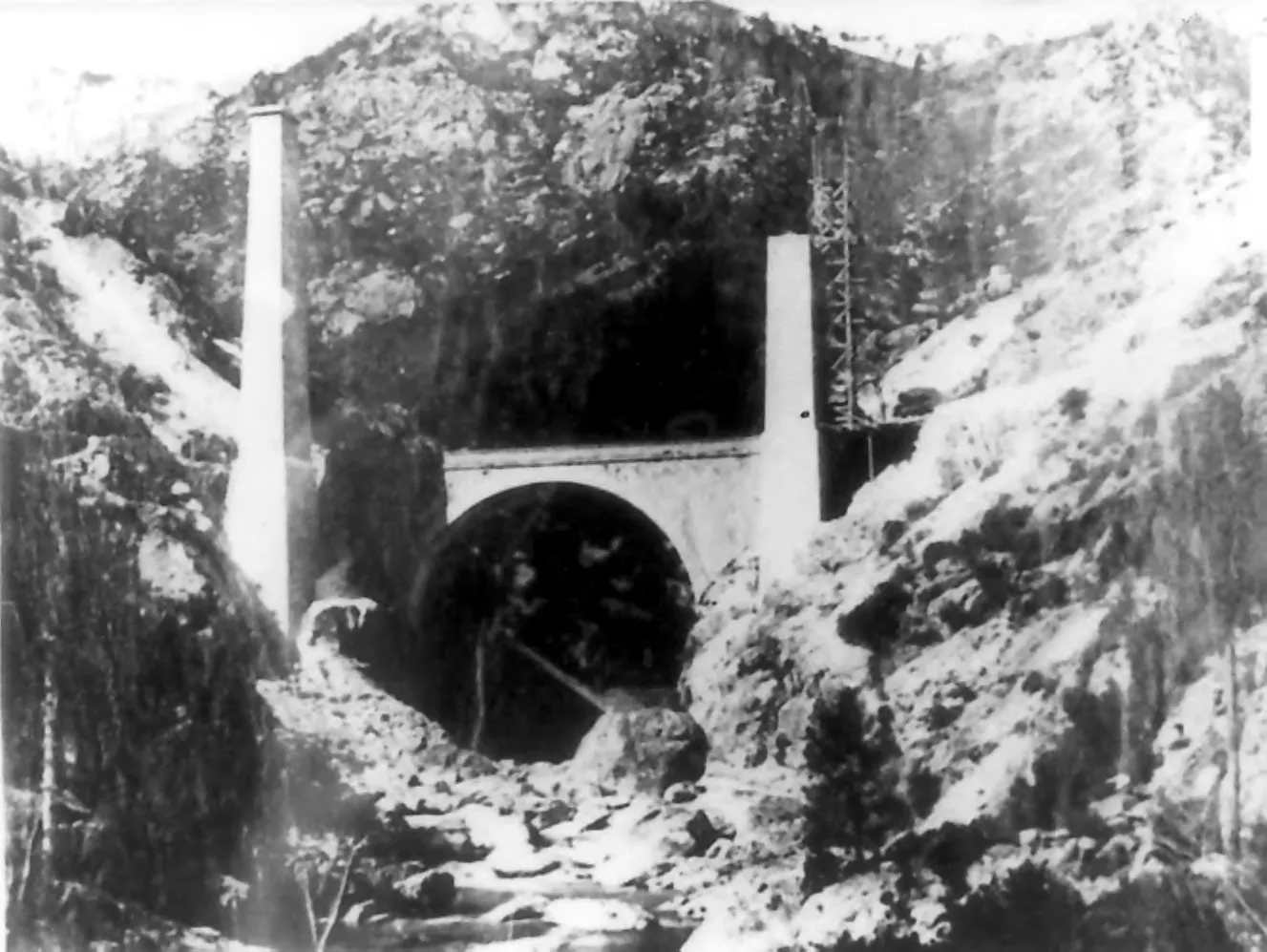
The Vecchio viaduct under construction in the early 1890s. The two large masonry piers are already standing, while the future metal deck has yet to be installed. Collection Jean Melero.
Bastia–Ajaccio: the continuous route is complete.
On 3 December, the opening of the Vivario–Corte section completed the last missing link and finally established a continuous railway between Bastia and Ajaccio. The 33 kilometres between Corte and Vizzavona had taken five years to build and included 23 tunnels and 11 viaducts along a particularly difficult route, notably featuring the spectacular Vivario loop. The central line was now complete over 157.4 kilometres. Built to metre gauge, it crossed Corsica through its mountainous interior: gradients reached 30‰ in the most difficult sectors, while the 3,916-metre Vizzavona tunnel crossed the mountain on a gradient of 20‰.

The Bastia–Ajaccio line in figures: distances, tunnels, gauge and gradients.
The network faces the realities of operation
1895 is the first full year of operation of the basic network. The Chemins de fer départementaux record 221 886 passengers and carry 32 254 tonnes of goods.
These results remain modest, but traffic will gradually grow as the railway becomes part of Corsicans’ travel habits. Twelve years later, in 1907, the network carries 380 905 passengers and 120 337 tonnes of goods.
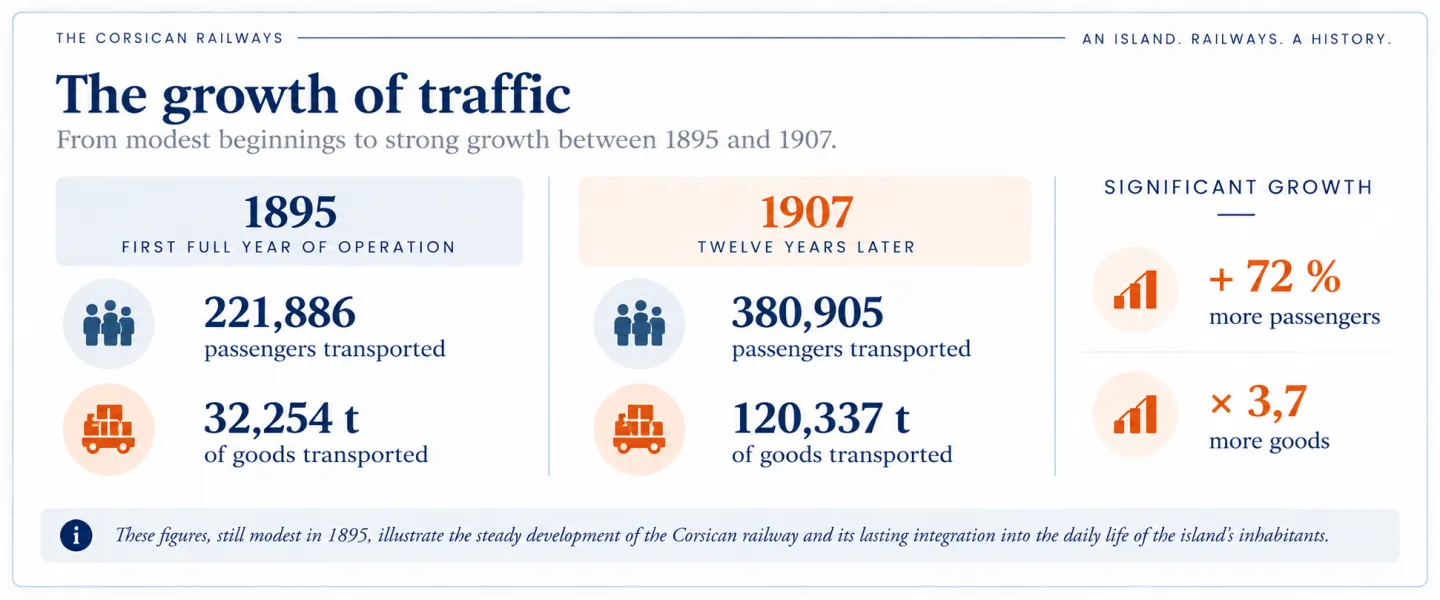
Passengers and goods carried in 1895 and 1907.
The railway reaches the ports
After completion of the main lines, the network gained direct connections to the ports. In Bastia, a railway connection was authorised by decree on 1 June 1896; Ajaccio followed with the decree of 4 March 1902. These tracks allowed the railway to reach the port installations directly and strengthened its role in carrying goods between ships, the two main cities and the island’s interior.
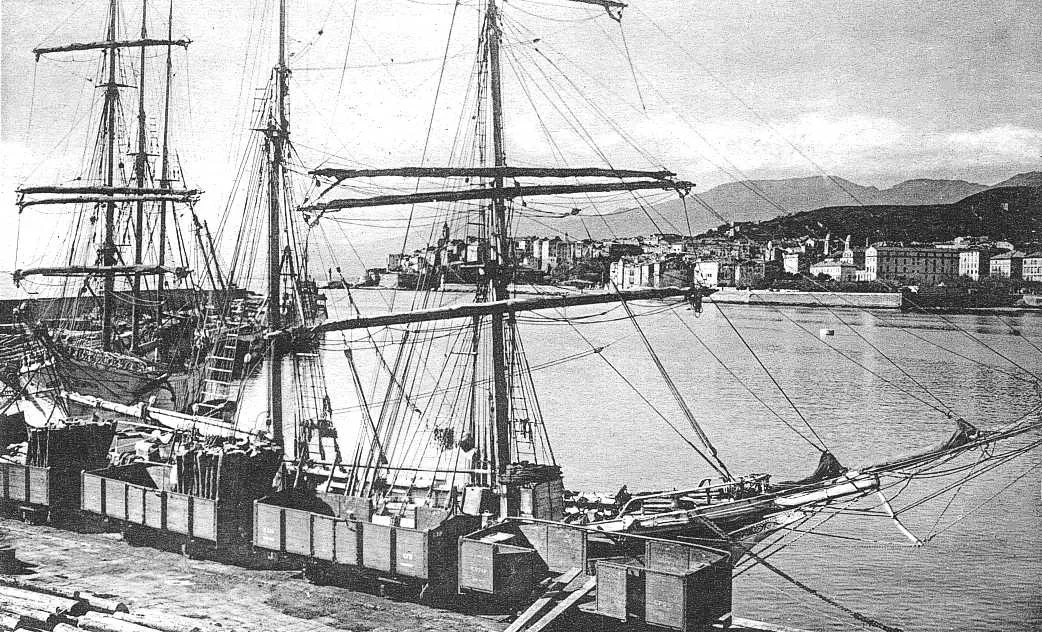
The railway at Bastia’s port. The tracks bring wagons alongside the ships and facilitate the transfer of goods between the port and the island’s network. Collection Luc Beaumadier. · traincorse.free.fr
A new agreement to operate the network
After more than twenty years of operation by the Compagnie de chemins de fer départementaux (CFD), the terms governing the Corsican network became the subject of new negotiations. The 1883 agreement, repeatedly extended, was criticised in particular for its payment arrangements, which were considered poorly suited to encouraging service development. The extension of the eastern line, which had ended at Ghisonaccia since 1888, also remained unresolved.
On 8 November 1909, the Minister of Public Works and the CFD signed a new agreement. It provided stronger financial incentives for the operator and entrusted it with building the extension from Ghisonaccia to Bonifacio. The project was intended to bring the railway to Solenzara, Porto-Vecchio and the far south of the island.
Two amendments, signed on 8 December 1910 and 4 July 1911, supplemented the agreement. The law of 1 December 1911 approved the agreement and its amendments, declared the Ghisonaccia–Bonifacio line to be of public utility and renewed the CFD’s operating lease for thirty years, until 31 December 1941.
The extension now had a contractual and legislative framework, but construction had yet to begin.
The railway must continue towards Bonifacio
On 1 December, the Ghisonaccia–Bonifacio line was declared to be of public utility. Around 106 kilometres long, it was to extend the east coast line towards Porto-Vecchio, then reach Figari and Bonifacio. Its initial construction cost was estimated at 14.7 million francs, excluding land acquisition.
This extension, envisaged since the Freycinet plan of 1879, was to complete the major railway along the east coast. The Compagnie des chemins de fer départementaux estimated that, after expropriations, building the line and its ten intermediate stations would take around three years. But history would decide otherwise: the First World War would interrupt the programme and delay the railway’s arrival in the far south by many years.
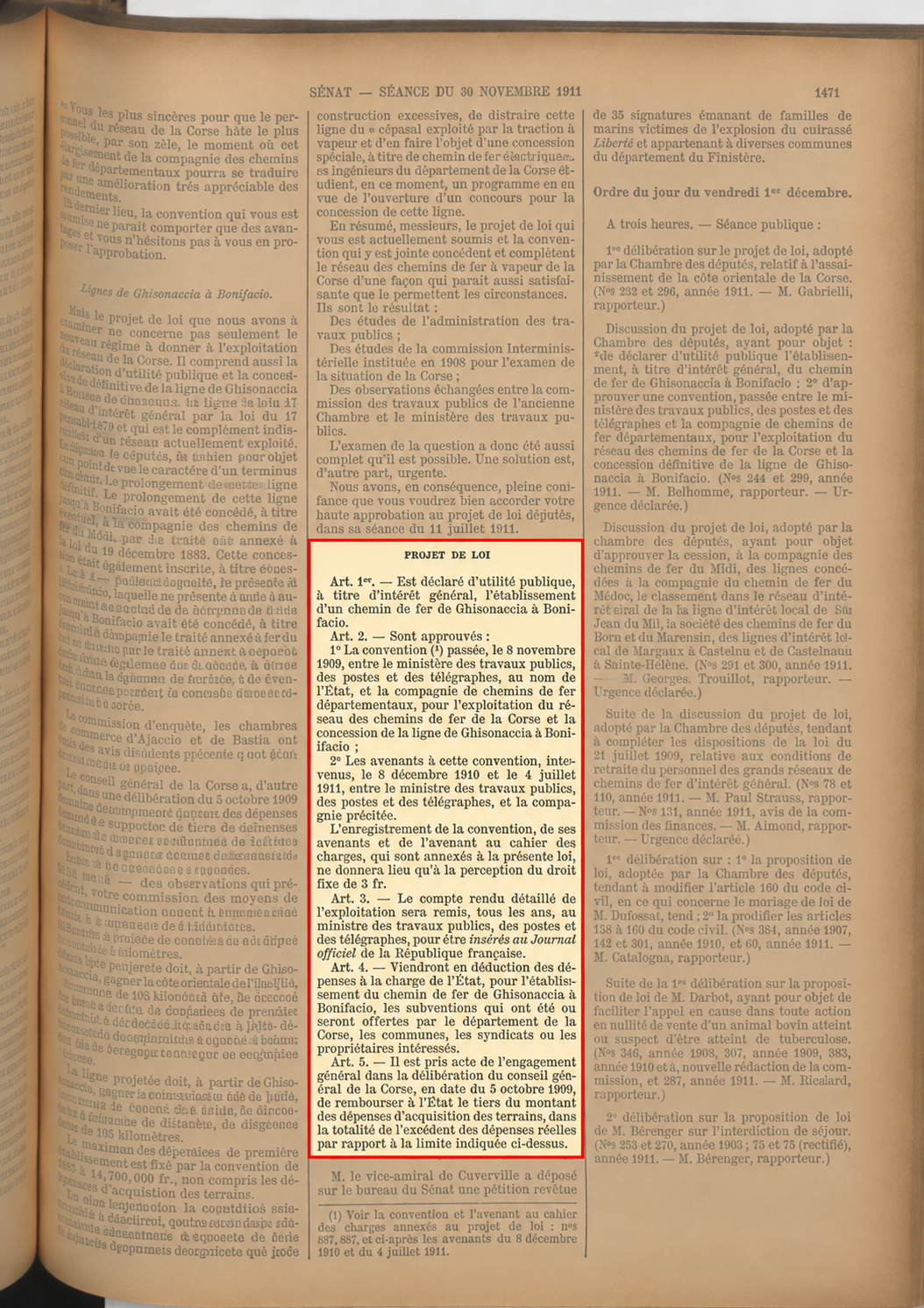
Extending the eastern line towards Bonifacio — 1911
Bill declaring the Ghisonaccia–Bonifacio line to be of public utility and approving the operating agreement concluded with the CFD in 1909.
Source: Journal officiel, Sénat, 30 novembre 1911, p. 1471 — BnF/Gallica.
A direct train between Bastia and Ajaccio
On 1 January, the CFD introduce a fourth daily Bastia–Ajaccio service, consisting solely of passenger coaches and covering the line in 6 hours, instead of the 7 hours 15 minutes to 8 hours required by mixed trains. This improvement marks a new stage in the operation of the central line, as passenger traffic continues to grow.
That same year, the network prepares a major renewal of its rolling stock. On 29 July, the purchase of eight passenger coaches, two assembled bogies and four vans is authorised; on 18 August, a further decision authorises the purchase of 80 goods wagons. The four vans and 80 wagons will be delivered before the beginning of 1915, while the war will delay the arrival of the passenger coaches.
The modernisation programme also concerns traction. A project proposes purchasing six Mallet-type compound locomotives with six coupled axles, weighing 38 tonnes empty, together with various spare parts. The total estimated cost is 575,000 francs. It is accompanied by plans to improve the facilities in Bastia, including turntables, an enlarged engine shed and improvements to the repair workshops.
On the eve of the First World War, the Corsican network is thus seeking to improve passenger journey times, its fleet of coaches and wagons, its tractive power and the facilities needed to maintain its rolling stock, all at the same time. The war will interrupt or delay some of these projects.

Corsican network timetables as of 1 January 1913 · Collection Luc Beaumadier. · traincorse.free.fr
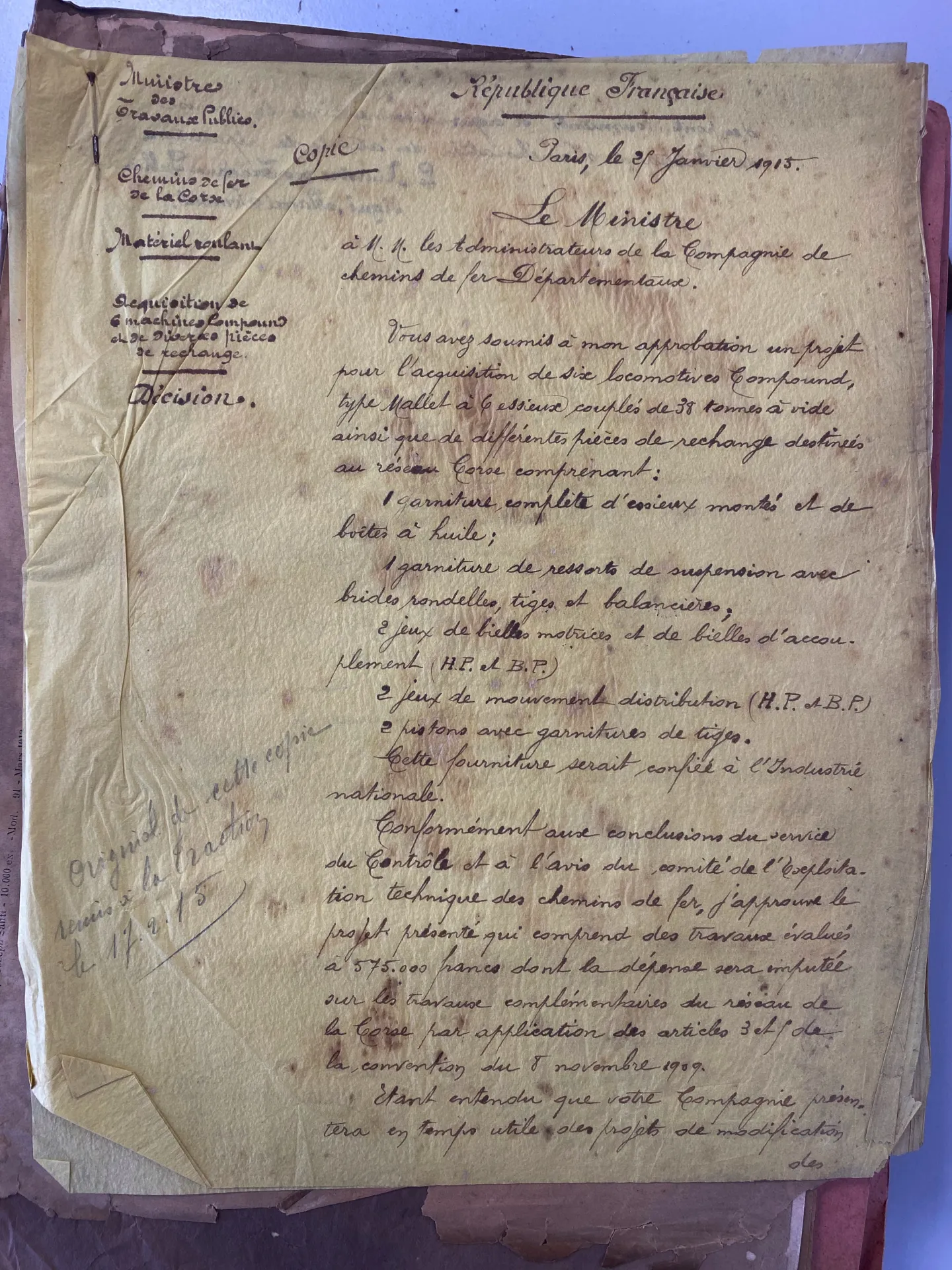
Traction renewal project — 1913
On 29 January 1913, the Minister of Public Works approves a project to purchase six Mallet-type compound locomotives with six coupled axles and spare parts, at an estimated cost of 575,000 francs. The programme also provides for improvements to the facilities in Bastia.
Ministère des Travaux publics, 29 janvier 1913.
Collection Pedro Navarro
War disrupts operations and halts construction
The First World War disrupted the work of the Compagnie des chemins de fer départementaux, which operated the Corsican network. Military mobilisation deprived it of a substantial part of its workforce. Across its various networks, passenger services were reduced while freight transport was called upon more heavily to meet military needs. The precise consequences for timetables and staffing on the Corsican lines nevertheless remain to be established.
The war also complicated supplies of coal for steam locomotives. In 1916, the Chemins de fer départementaux considered reopening the Osani mine to replace some of the fuel it could no longer bring from mainland France. The company secured the requisition of the site, but the abandoned facilities required major work. Transporting the coal posed another difficulty: carrying just ten tonnes a day to Calvi would require fifty teams of two horses. On 23 March 1916, the company asked the Minister of War to cancel the requisition. The project was abandoned.
Meanwhile, the extension of the eastern line from Ghisonaccia to Bonifacio, granted under concession in 1909, was interrupted by the conflict. Some of the work should have been completed before August 1914, but the war prevented it from being carried out under the agreed conditions.
After the armistice, rising material and labour costs made the financial terms of the original agreement unsuitable for continuing construction. In 1920, the state asked the company to resume the project, paving the way for revised agreements and a gradual resumption of the programme.
Saloon coaches for discovering Corsica
After the restrictions of the First World War, the network also seeks to improve passenger comfort. Four coaches ordered before the war are accepted on 2 March 1921 and enter service on 18 April. In addition to their first- and second-class compartments, they have a proper saloon compartment at one end, occupying the full width of the coach.
Eight luxury seats are offered in this extensively glazed space, furnished with armchairs, sofas and a folding table so that passengers can enjoy the scenery. A special fare is approved on 27 June: access to the saloon carries a 25% supplement over the first-class fare. It takes effect on 9 July 1921.

The Corsican network’s new saloon coaches — 1921
Notice describing the four coaches introduced on 18 April 1921 and their saloon compartment, fitted out to allow passengers to enjoy the scenery.
Collection Pedro Navarro

Eight luxury seats in the saloon coaches
Proposed special fare providing eight seats in the saloon compartment, available for a 25% supplement over the first-class fare.
Collection Pedro Navarro
The project resumes, but only as far as Solenzara
Following the interruption caused by the First World War, the east coast extension returns to Parliament. The line under concession between Ghisonaccia and Bonifacio covers 105 kilometres, but the substantial increase in material and labour costs makes immediate construction impossible under the financial terms agreed before the war.
The State therefore decides to limit the initial work to a 25-kilometre section between Ghisonaccia and Solenzara.
A new supplementary agreement is signed with the CFD on 17 February 1922: it requires work to begin within three months of the law’s promulgation and to be completed within three years.
The maximum cost of this first section is set at 14.85 million francs, including 650 000 francs reserved for rolling stock, station furniture and workshop equipment.
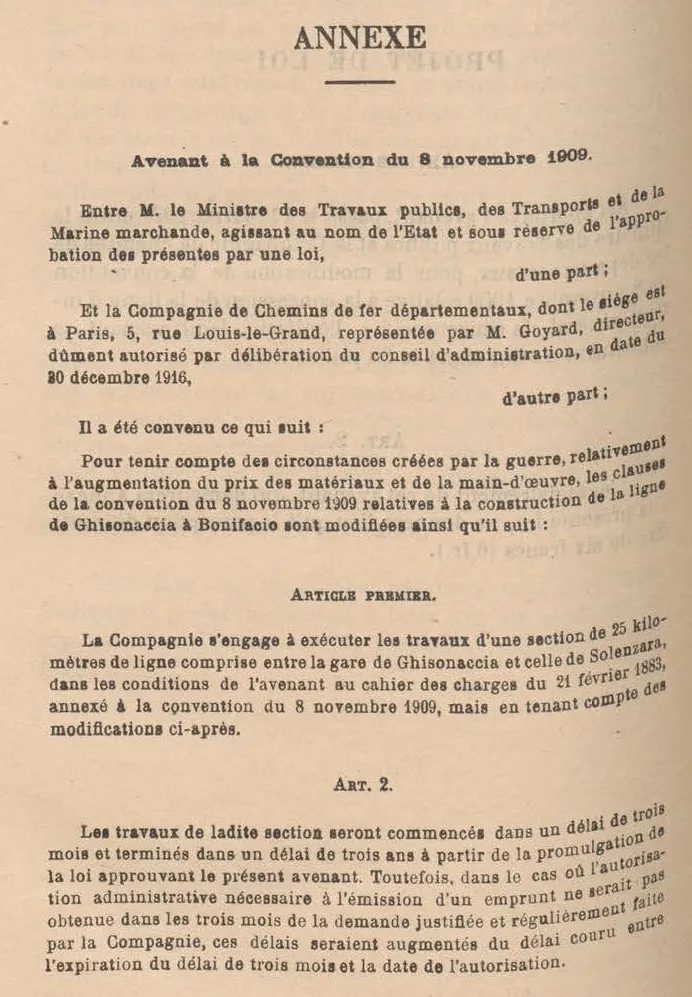
Supplementary agreement for the construction of Ghisonaccia–Solenzara — 1922
Signed on 17 February 1922, this supplement to the 1909 agreement provides for the construction of a first 25-kilometre section between Ghisonaccia and Solenzara. It sets deadlines of three months to begin work and three years to complete it after the law’s promulgation.
Rapport Chanal, Sénat, n° 305, 6 avril 1922 — Source: Gallica / Bibliothèque du Sénat.
Construction slowed by financial difficulties
Following the amendment of February 1922, which initially limited the eastern coast extension to the Ghisonaccia–Solenzara section, work began gradually in 1923. But economic conditions had changed profoundly since the 1909 concession. Inflation, rising material prices and funding difficulties delayed construction.
The contractors encountered difficulties in turn and repeatedly requested the termination of their contracts. In June 1926, the departure of Italian workers caused another interruption to the work.
The extension project was also reviewed. By a ministerial decision of 6 August 1928, the next extension was provisionally limited to Porto-Vecchio, without definitively abandoning the goal of reaching Bonifacio.
On 25 March 1929, the administration authorised the launch of work on the next section. Actual construction would not begin until later, however. On the first section, work continued until the opening of Ghisonaccia–Solenzara on 15 September 1930.
Meanwhile, the financial terms for operating the network were reformed. In a report presented to the Senate on 24 January 1929, Fernand Rabier highlighted the shortcomings of the system introduced in 1922, which had already been amended several times. The remuneration provided for in the agreements did not give the company sufficient incentive to develop traffic. New agreements, concluded in July 1928, provided a more flexible payment formula intended to reconcile the interests of the state and the operator more effectively.
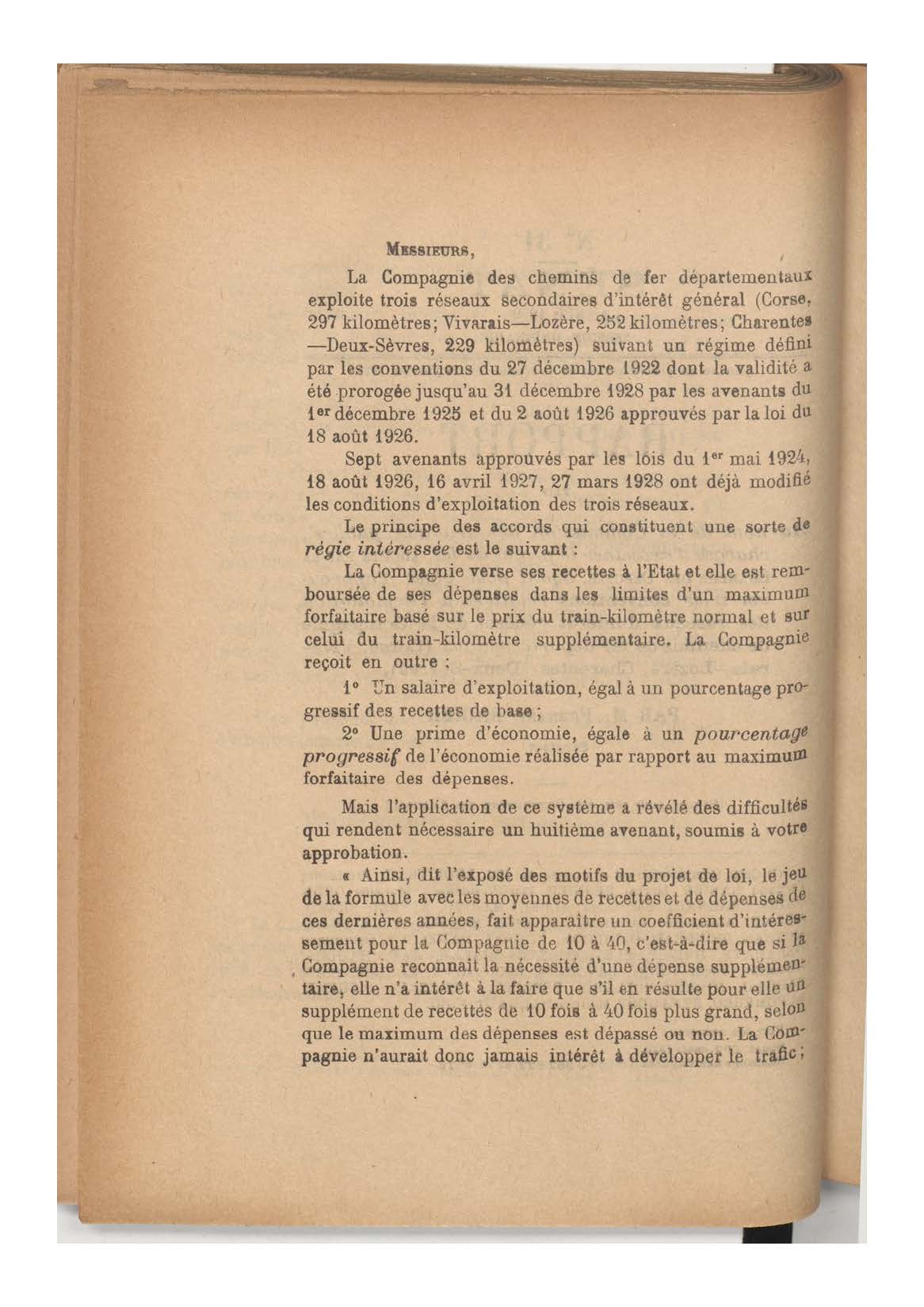
Reforming the operating terms — 1929
Fernand Rabier’s report highlights the network’s financial difficulties and the shortcomings of the CFD’s remuneration system.
Source: Sénat, rapport n° 31, 24 janvier 1929, p. 2 — Gallica / Bibliothèque nationale de France.
The eastern line reaches Solenzara.
After several years of work, the extension of the east coast line from Ghisonaccia reached Solenzara. This 25-kilometre section was the first completed part of the vast project declared of public utility in 1911, which had originally been intended to take the railway all the way to Bonifacio. But Solenzara was to be only an intermediate stage.
On 29 March 1930, a new supplementary agreement was concluded with the Compagnie des chemins de fer départementaux to continue construction for 41 kilometres to Porto-Vecchio. The administration considered that a terminus at Solenzara, then a modest settlement of around 300 inhabitants, would prevent the line from fulfilling its economic role.
Porto-Vecchio, by contrast, was an important port and a centre for trade in cork, timber and charcoal. The project was approved by the Chamber of Deputies on 25 April 1930 and then submitted to the Senate. Bonifacio nevertheless remained the final objective. Parliamentary documents still described the town as the ‘rational terminus’ of this major line intended to run the length of Corsica’s east coast. The railway thus continued its southward advance, almost forty years after the line’s first sections had opened.
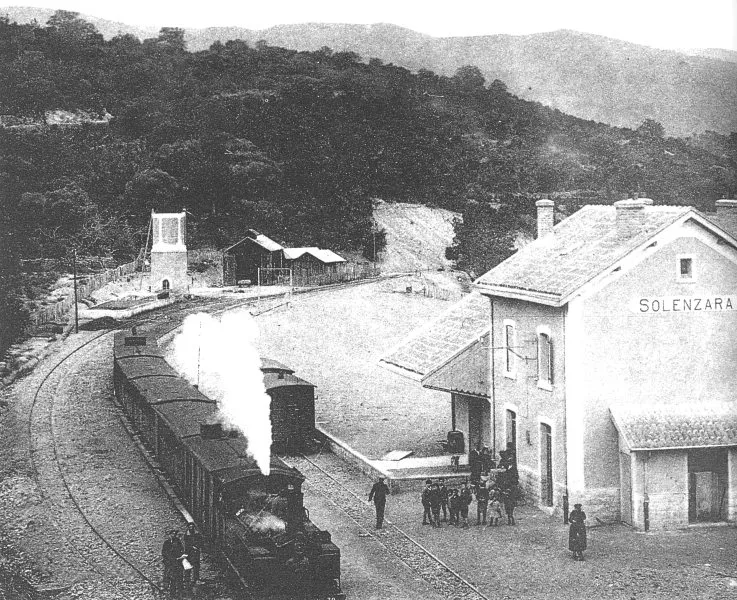
Solenzara station and its steam train. A train stands at Solenzara, the temporary terminus of the east coast line from 1930, before the railway continued towards Porto-Vecchio. Collection Luc Beaumadier. · traincorse.free.fr
The CFD order a Billard prototype.
On 1 June 1934, the CFD placed an order with Billard, in Tours, for a diesel railcar designed specifically for the Corsican network. Designated A 210 D No. 101, the prototype was intended to provide a more modern and economical solution for passenger services.
Measuring 17.595 metres and fitted with a 210 hp MAN diesel engine, it was designed to seat 41 passengers in two compartments. It also included a mail compartment, toilets and luggage space.
The order marked a further step in modernising the rolling stock, at a time when railcars were beginning to play a growing role in railway operations.
The first Billard arrives in Bastia.
On 15 June 1935, the Billard A 210 D No. 101 prototype, ordered the previous year, was delivered to Bastia. Its arrival introduced a new generation of diesel railcars to the Corsican network.
The initial results soon persuaded the CFD to continue renewing the fleet. On 29 July 1935, just six weeks after the prototype was delivered, five additional railcars were ordered, the future A 210 D Nos. 102 to 106.
This new order confirmed the intention to expand the use of railcars to modernise services and gradually renew the passenger rolling stock.

Class layout in the 210 hp railcars
Operating plan showing the seating arrangement in the 210 hp railcars, together with the spaces reserved for the engine and luggage.
Operating document of the Chemins de fer de la Corse.
Collection Pedro Navarro
The east coast as far as Porto-Vecchio.
On 21 September, the Solenzara–Porto-Vecchio section opens to traffic. Almost half a century after the first openings on the east coast, the line thus reaches Porto-Vecchio. The Corsican network now reaches its greatest extent, with 360.470 kilometres of main lines.
Yet 39.685 kilometres still remain to be built to reach Bonifacio. The technical design has been ready for several years and the land has already been acquired.
But between 1930 and 1935, a fall in construction costs, estimated at around 14%, leads to a new financial disagreement: the administration wishes to reduce the lump sum granted to the CFD, while the company has already entered into fixed-price contracts.
Discussions continue until 1939 without allowing work to begin on the final section. The outbreak of the Second World War finally brings the Porto-Vecchio–Bonifacio project to an end.

Proposed railway route towards Bonifacio — graphic reconstruction based on the original plan.
Source: Archives départementales de la Haute-Corse — original document; graphic reconstruction: Train Corse.
Production Billard railcars take over.
The production railcars gradually join prototype no. 101. Nos. 102 and 103 arrive in Bastia on 1 July 1936, followed by nos. 104 to 106 on 10 January 1937. The CFD now have six A 210 D railcars, designed for the needs of the Corsican network.
Their arrival marks an important stage in modernising operations: the railcars enable faster passenger services to develop alongside steam trains.
From March 1937, services connecting with passenger ships become daily. The railcar thus plays a growing role in journeys between the island’s main towns and in connections with sea services.
In 1938, their use also extends to Balagne and Porto-Vecchio, taking the new services beyond the central line alone.
Within a few years, the Billard railcars therefore move from experimental prototype to regular network rolling stock. Steam does not disappear: locomotives and railcars coexist, but the latter introduce a new way of operating passenger services, better suited to faster journeys.

Arrival in Bastia of a Billard 100 railcar and its powered bogie — July 1936. Collection Jean Melero.
The CFD’s operating lease is extended
The Second World War disrupted relations between the management of the Corsican network and the Paris headquarters of the Compagnie des chemins de fer départementaux (CFD). The temporary relocation of general management to Saint-Jean-d’Angély complicated communication. In Corsica, the local director had to keep the network running with greater autonomy.
As the previous agreement expired on 31 December 1941, a new agreement extended the operating lease for five years. It was signed on 1 December 1941 and approved by the law of 26 February 1942.
On 11 November 1942, Italian troops occupied Corsica. The railway continued to operate amid war and the increasing isolation of its local management.
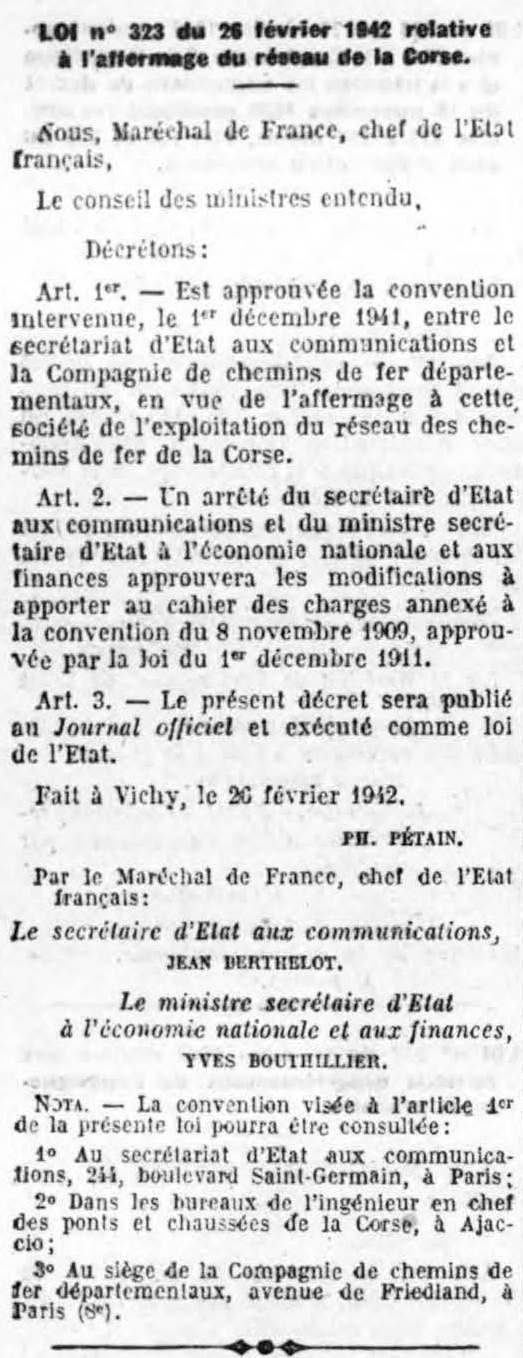
Renewal of the operating lease for the Corsican network — 1942
Law no. 323 of 26 February 1942 approves the operating lease agreement concluded on 1 December 1941 for a five-year term, enabling the Compagnie de chemins de fer départementaux to continue operating the Corsican railways.
Journal officiel de l'État français, n° 53, 3 mars 1942, p. 884 — loi n° 323 du 26 février 1942. Source: Journal officiel archives, available on Légifrance.
War severs the eastern line.
In September 1943, during the fighting for the Liberation of Corsica and the German forces’ retreat towards Bastia, the east coast line suffers extensive destruction. Eighteen bridges are completely or partly destroyed, including several major crossings of coastal rivers, among them the bridge over the Tavignano, the largest on the line.
Many railway buildings are also hit, and the rolling stock suffers heavy losses: 15 locomotives, 3 railcars, 25 coaches and 250 wagons are damaged.
The Casamozza–Porto-Vecchio line, completed only eight years earlier, becomes unusable over much of its length. At the Liberation, the Corsican network is profoundly disrupted, and rebuilding the east coast line becomes one of the major post-war challenges.
Unlike the central and Balagne lines, it will never regain its pre-war operation: only the northern part will reopen, while Porto-Vecchio will remain permanently cut off from the railway network.
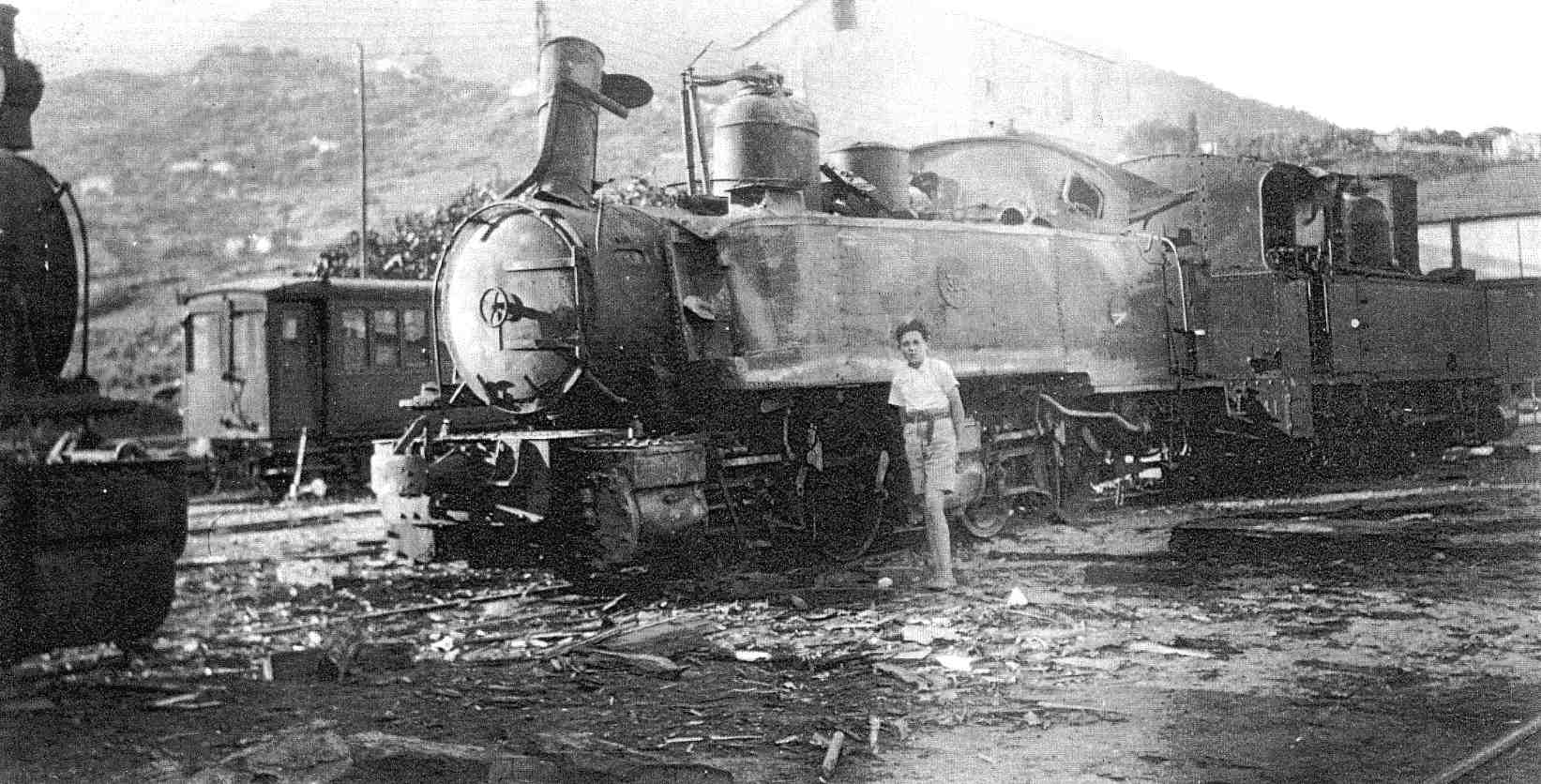
Corsica's railways scarred by war — 1943
A damaged train photographed in Bastia in October 1943 bears witness to the destruction suffered by Corsica's railway network during the Second World War. In 1943, damage to infrastructure, particularly on the east coast line, severely compromised its operation for years to come.
Credit: Jean Melero.
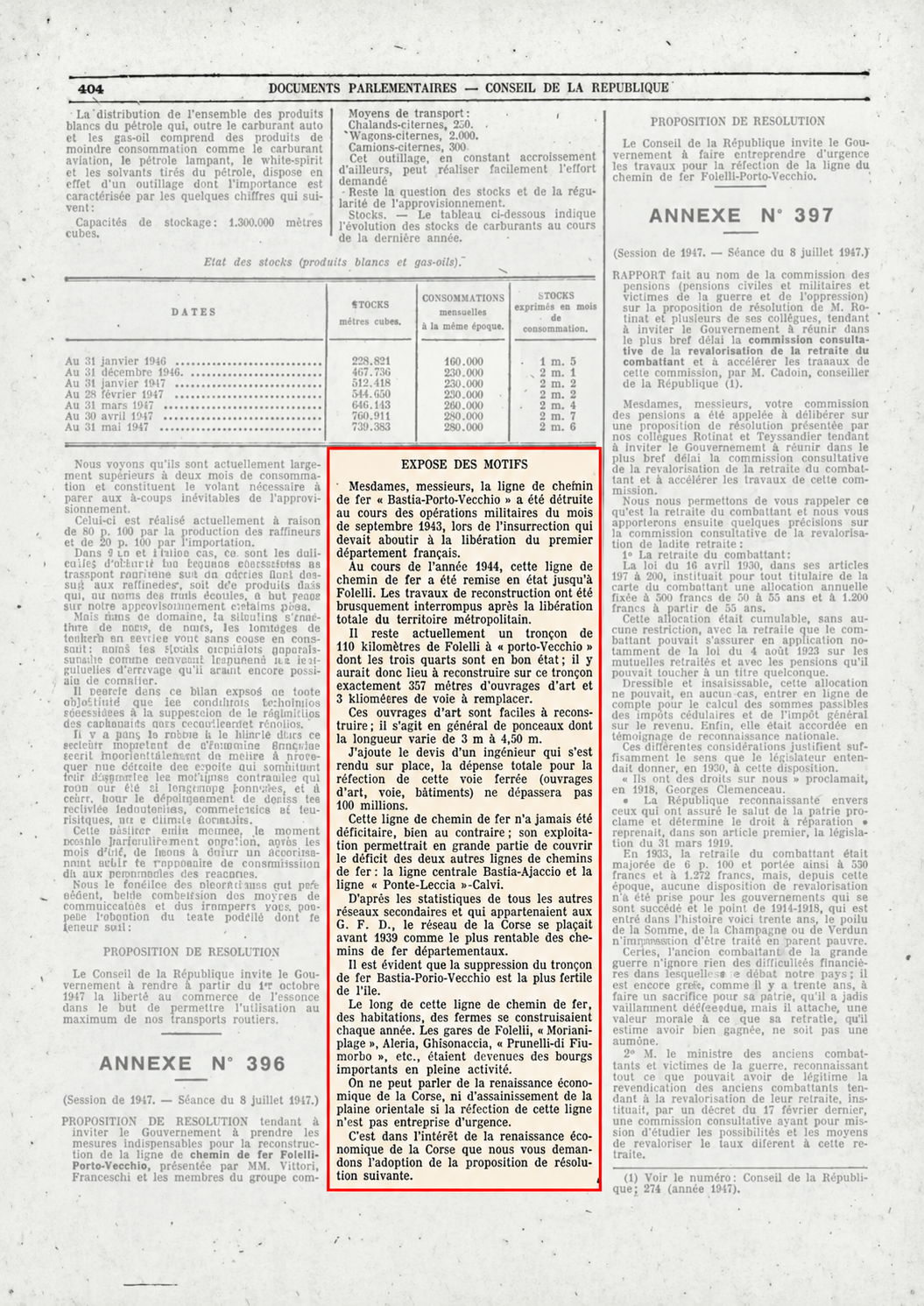
The destruction of 1943 and the unfinished reconstruction of the east coast line.
In July 1947, a parliamentary proposal recalls that the Bastia–Porto-Vecchio line was destroyed during the military operations of September 1943 and was subsequently restored only as far as Folelli.
Conseil de la République, proposition de résolution n°396, 8 juillet 1947.
The railway helps supply the island
After the Liberation of Corsica, the destruction of September 1943 made transport considerably more difficult. With the port of Bastia inaccessible to supply traffic and navigation along the eastern coast considered dangerous, supplies arriving from mainland France passed mainly through Ajaccio. The railway helped carry them inland, particularly to meet the needs of the population and of French and Allied forces.
The central line had also suffered damage. Between Casamozza and Ponte-Novu, several structures were hit, while the Torretta tunnel in Bastia was damaged. From November 1943 to 10 July 1944, services on the affected part of the line remained limited to Barchetta. To help restore rail connections, six locomotives were shipped from Algeria, together with bridge components.
The reconstruction of the eastern line nevertheless remained uncertain. This line had previously accounted for more than half the network’s revenue. The company made continued operation conditional on its restoration. On 1 July 1945, it ceased operating the network under the provisional arrangements and relinquished its operating lease.
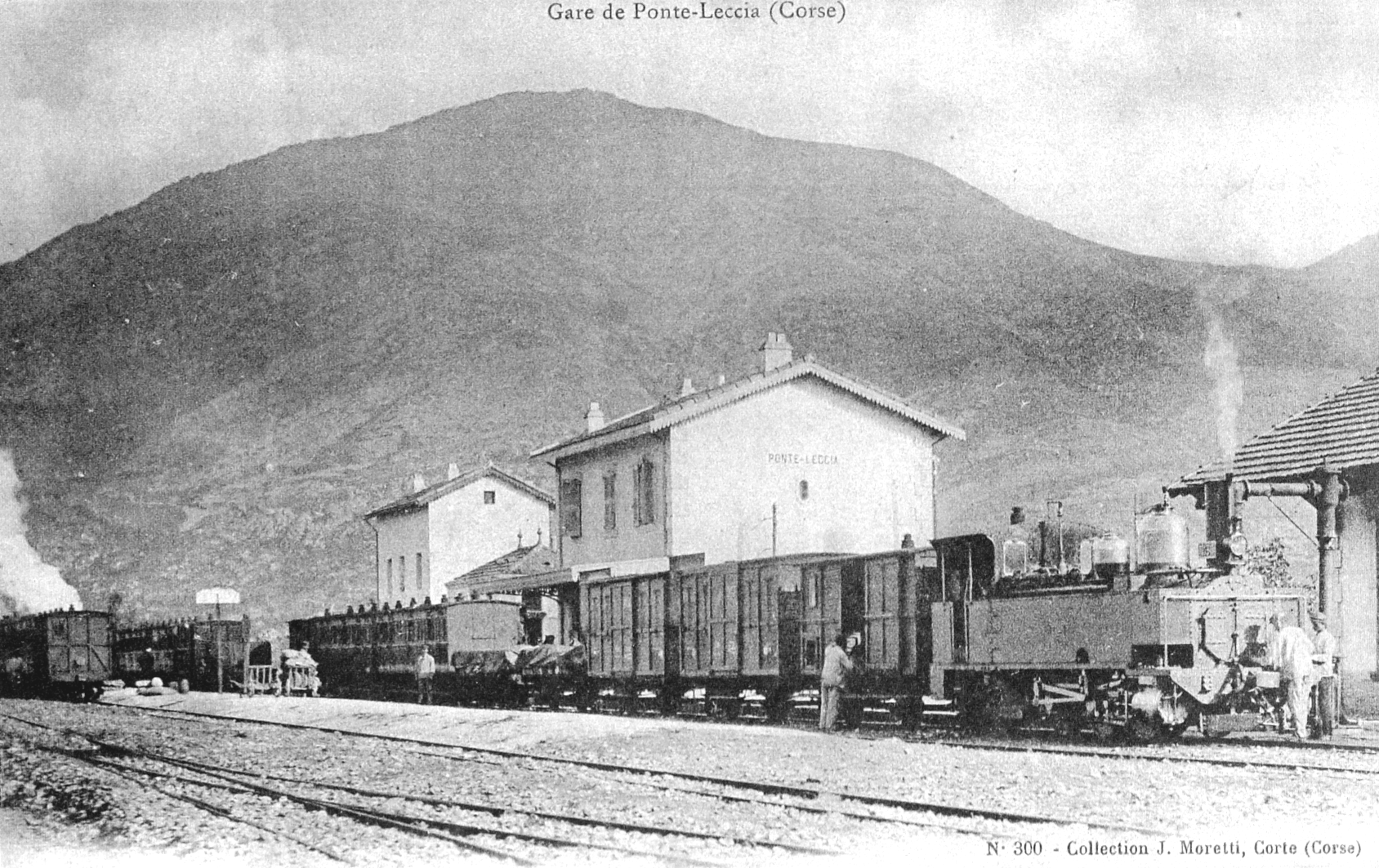
A mixed Bastia–Ajaccio train at Ponte-Leccia before the war
Fives-Lille 031 T steam locomotive no. 34 at the head of a mixed train combining passenger coaches and freight wagons. After the Liberation of Corsica, rail freight played an important role in carrying supplies from Ajaccio.
Photograph taken before 1937 — exact date unknown.
Collection Luc Beaumadier – traincorse.free.fr.
Parliament calls for the eastern line to be rebuilt
Four years after the destruction of September 1943, reconstruction of the eastern coast line remained unfinished. Repairs had restored services as far as Folelli in 1944, but work had then stopped. On 8 July 1947, councillors of the Republic François Vittori, Franceschi and several of their colleagues tabled a motion calling for work to resume as far as Porto-Vecchio.
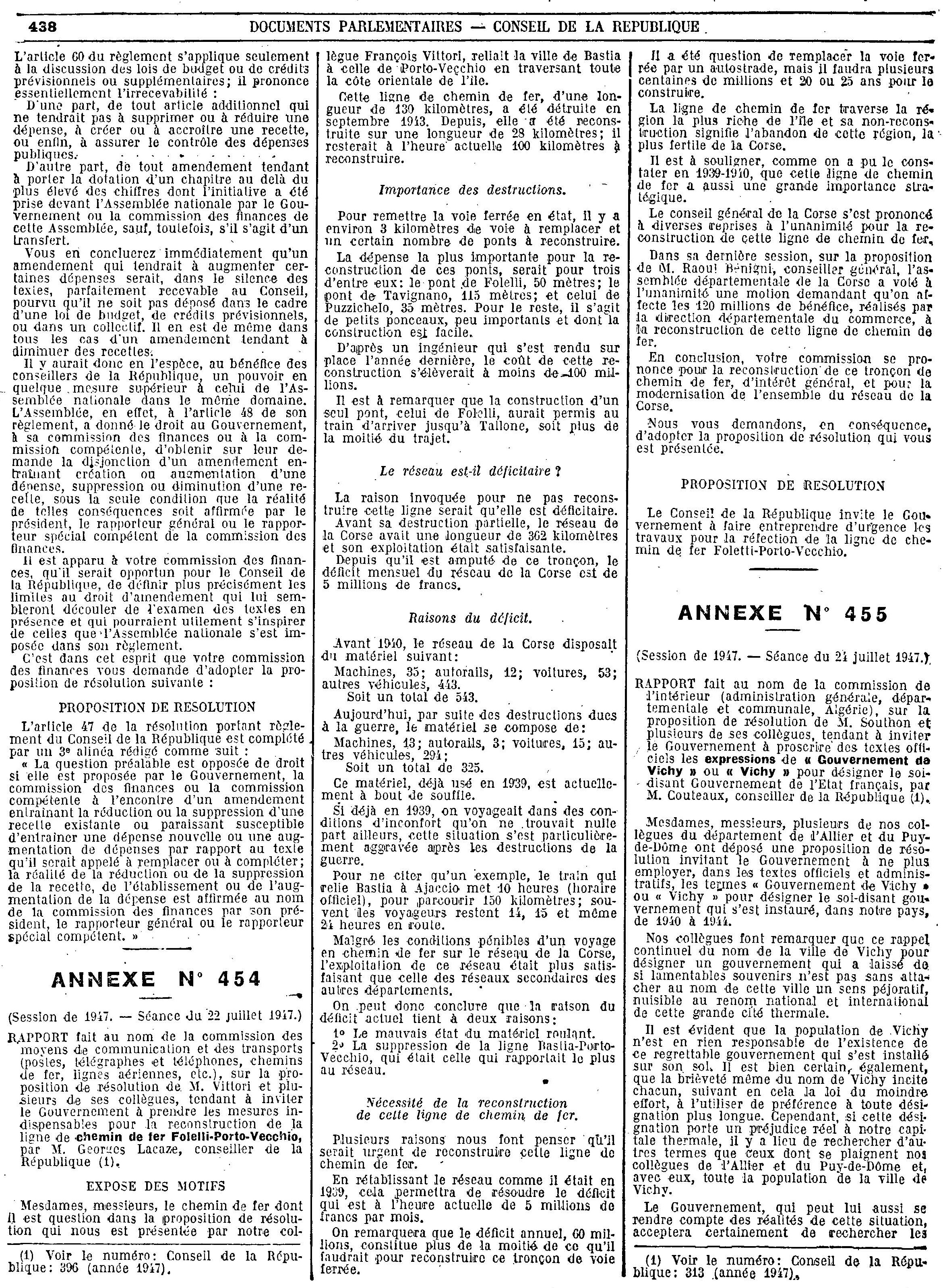
In his report of 22 July, Georges Lacaze estimated that around 130 kilometres of line remained to be rebuilt. According to the estimates presented, only three kilometres of track and 357 metres of engineering structures would require replacement or reconstruction. The three main bridges concerned were those at Folelli, Tavignano and Puzzichello, measuring 50, 115 and 35 metres respectively. The total cost of the work was estimated at less than 100 million francs.
The report highlighted the economic consequences of the interruption of the eastern line, regarded before the war as the most profitable part of the network. The operating deficit was then estimated at five million francs a month. The destruction had also considerably reduced the available rolling stock: according to the figures presented to parliamentarians, the network had only 13 locomotives and three railcars left, compared with 35 locomotives and twelve railcars before 1940.
The elected representatives feared that abandoning the eastern line would jeopardise the future of the other lines, particularly the route from Ponte-Leccia to Calvi. Corsica’s General Council had also repeatedly supported reconstruction.
On 5 August 1947, the Council of the Republic adopted a resolution without debate urging the government to restore the line from Folelli to Porto-Vecchio as a matter of urgency. Despite this intervention, work did not resume and the eastern line ceased operating for good on 1 July 1953, when the Casamozza–Folelli section closed.
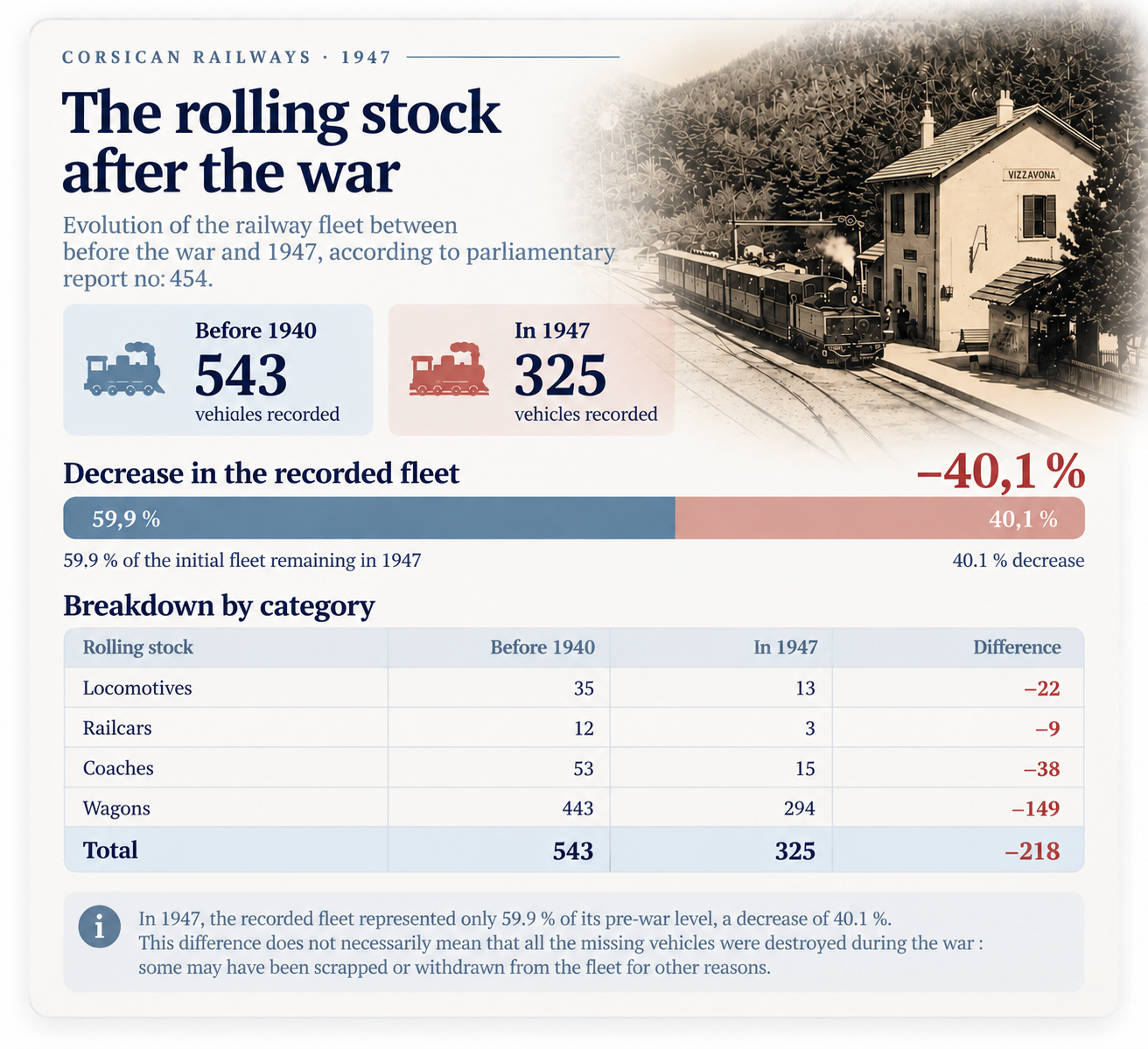
Source: Conseil de la République, rapport n° 454 présenté par Georges Lacaze, 22 juillet 1947, p. 438. Figures reproduced from the original document.
The Renault ABH 8 arrive in turn.
After the destruction of the war, the network continues to modernise its fleet. Ordered in 1947, eight Renault ABH 8 railcars, numbered X 201 to X 208, are built specifically for Corsica. The first is unloaded in Bastia on 10 December 1949; deliveries continue through the winter, and the eighth unit arrives on 10 February 1950. Regular service begins on 13 March with no. 205.
Robust and powerful, the ABH 8 railcars develop 300 horsepower and can reach 75 km/h. The first four units, equipped with a bar, offer 40 seats, and the next four offer 44. Their weight and axle load mean they are intended mainly for the central Bastia–Ajaccio line. They frequently run with a trailer to increase capacity.
Their arrival accompanies the profound transformation of post-war operations. From 1950, railcars take over most passenger services and steam traction declines rapidly. The Renault units thus become one of the Corsican network's emblematic classes and enjoy exceptionally long careers, with some remaining in service for several decades.
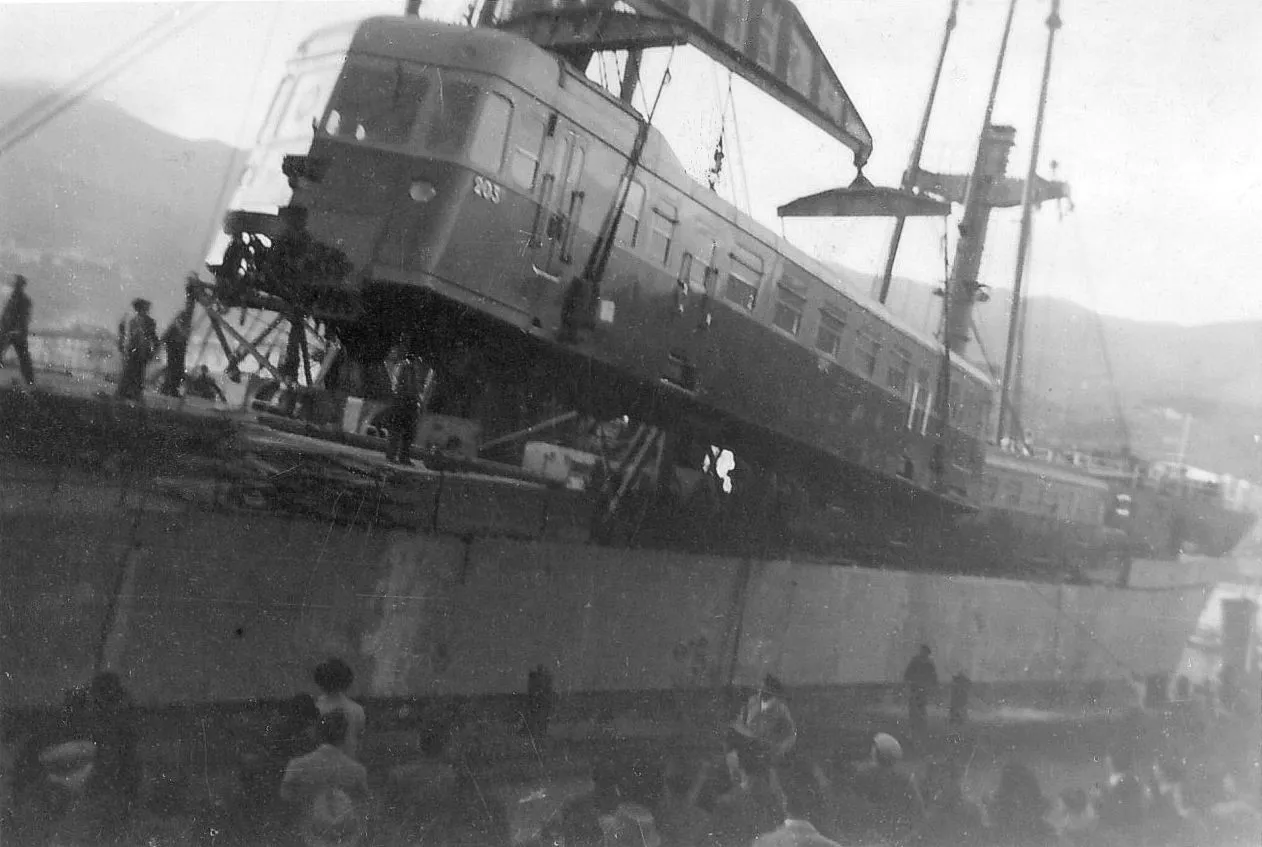
Unloading Renault railcar No. 203, probably in 1949. A second railcar is visible in the background.
Photo: Saliceti collection — Source: traincorse.free.fr.
The east coast line disappears for good
After the destruction of September 1943, only the northern part of the former east coast line had resumed railway operations between Casamozza and Folelli-Orezza. As plans to rebuild the line towards Porto-Vecchio ultimately came to nothing, this final section remains, for almost ten years, the last operating remnant of the old line.
On 1 July 1953, railway operations between Casamozza and Folelli cease in turn. Casamozza junction thus loses its southbound branch for good, and the Corsican network is reduced to the two lines that survive today: the Bastia–Ajaccio route and the Balagne line to Calvi.
The railway escapes closure
At the end of the 1950s, the future of the Corsican railways was directly threatened. Following an initial proposal targeting the Balagne line in 1955, the government considered closing the entire network in 1959, judging it too unprofitable, and replacing it with road services.
During debates on the 1960 budget, Corsican parliamentarians opposed this decision. They highlighted the difficulties of replacing the train in mountainous regions, particularly in winter, and the consequences for railway workers and the communities served. On 8 December 1959, a two-hour strike brought together several sectors of activity on the island against closure of the network.
The Finance Act for 1960 provided for the proceeds from the sale of railway installations to be allocated to improving Corsica’s roads, while making the actual closure of the railway conditional on adapting the road network and introducing replacement transport services.
During 1960, the state restored the funding needed to continue operations: an initial subsidy covered the first half of the year, followed in November by a transfer of 910,000 new francs to fund the second half. Meanwhile, 4.16 million new francs were authorised for roadworks preparing for the transfer of traffic.
Opposition continued. In December 1960, the Association of Corsican Mayors called for the network to be retained and threatened an administrative strike. The government then acknowledged that no date had yet been set for the transfer to road transport. Despite the preparations for closure, the railway continued to operate.
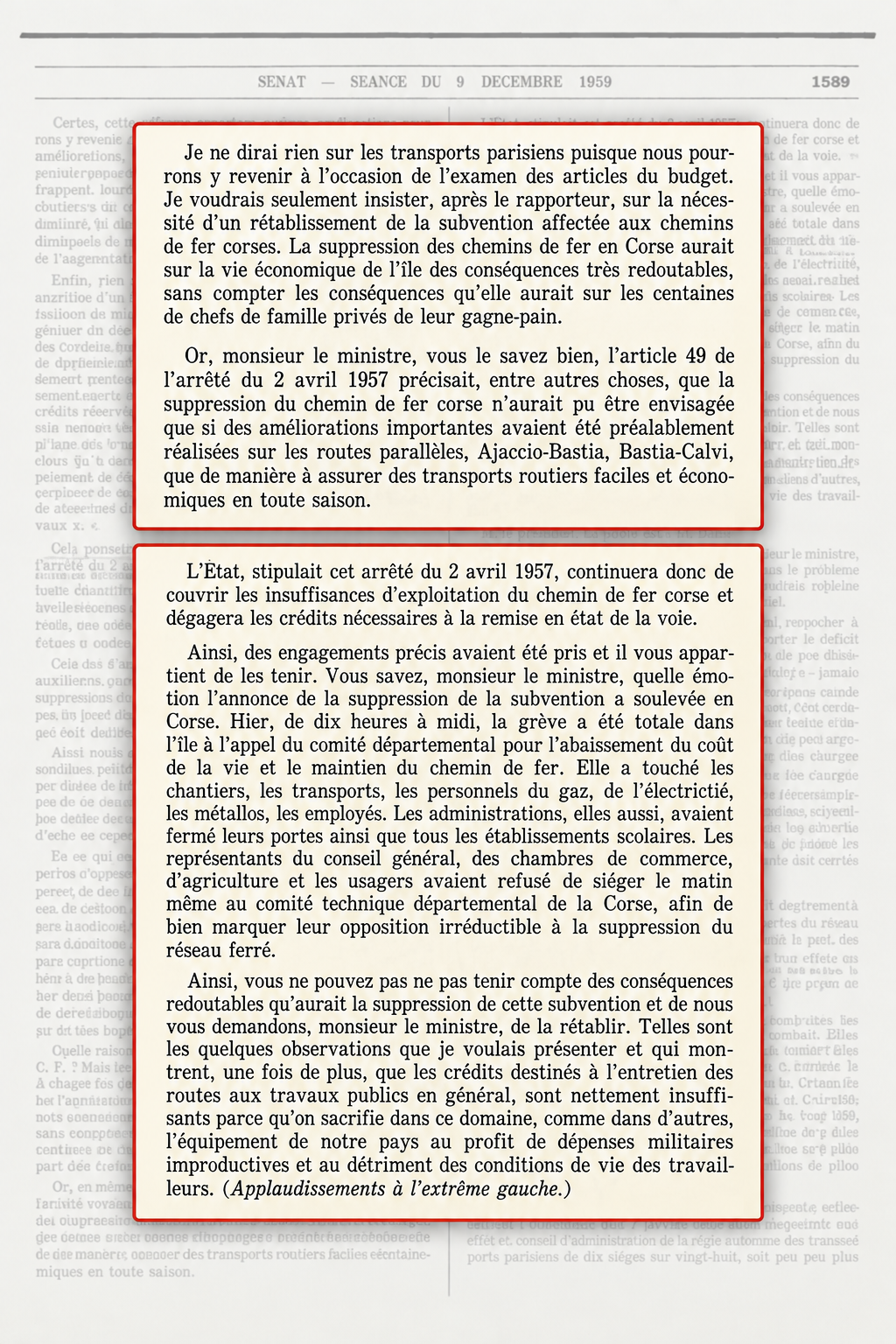
Mobilisation against railway closure — 1959
On 8 December, a two-hour strike mobilised Corsica against the rising cost of living and the proposed closure of the railway network.
Source: Journal officiel, Sénat, 9 décembre 1959, p. 1589.
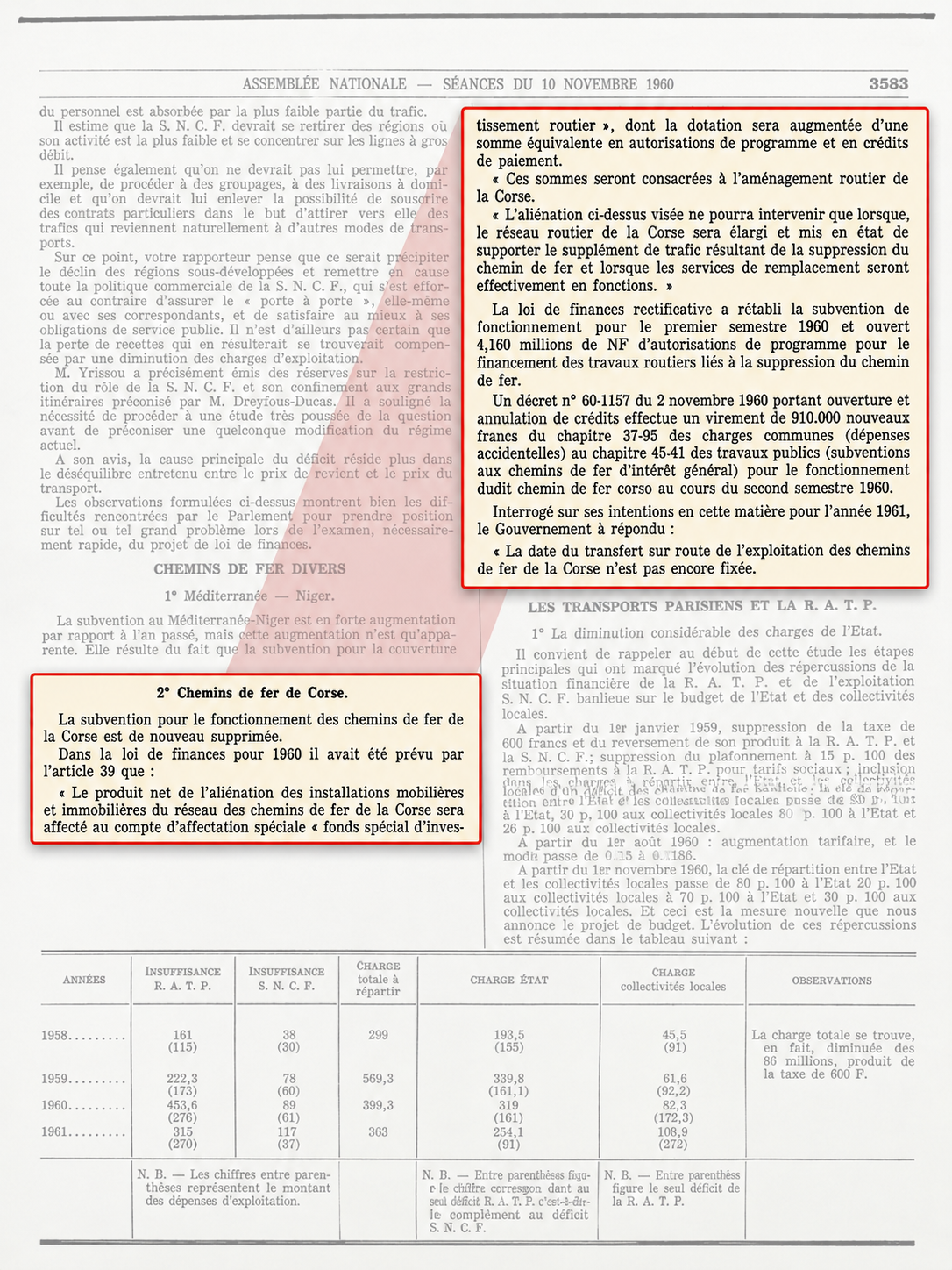
Railway closure still under consideration — 1960
Despite preparations to replace trains with road transport, the state continued to fund railway operations in 1960, without setting a closure date.
Source: Journal officiel, Assemblée nationale, 10 novembre 1960, p. 3583.
A new operator to modernise the network
On 1 June 1965, five years after escaping closure, the network changed operator. An agreement signed on 16 April 1965 and approved by decree on 29 May entrusted operation of the Corsican railways to the Société auxiliaire pour les chemins de fer secondaires (SACFS). The concession was granted for 14 years and 7 months. However, the railway property and rolling stock remained State-owned and were made available to the new operator.
Services soon evolved. In Balagne, the train-tramway introduced an enhanced summer service between Calvi and L'Île-Rousse, serving the coast and its beaches. Fast Bastia–Ajaccio services were also introduced on the central line. Operated by light railcars without trailers, they linked the two towns in 2 hours 55 minutes, with only a few intermediate stops.
The network changes operator again
After seven years of operation, the SACFS's financial position deteriorated sharply. By the end of 1971, unpaid debts had accumulated to the point where the company could no longer pay December's wages, threatening the continuity of rail services. On 6 January 1972, the State intervened by placing the network under administrative sequestration. The following day, its operation was provisionally entrusted to the Société générale de chemins de fer et de transports automobiles, while the SACFS declared that it was unable to pay its debts on 8 January.
Its concession was officially revoked by ministerial order on 31 January 1972; the company would enter judicial liquidation on 20 March. The network therefore continued to operate under temporary administration on behalf of the State. This transition opened a new period of modernisation, soon to be marked by track renewal and the arrival of new railcars.
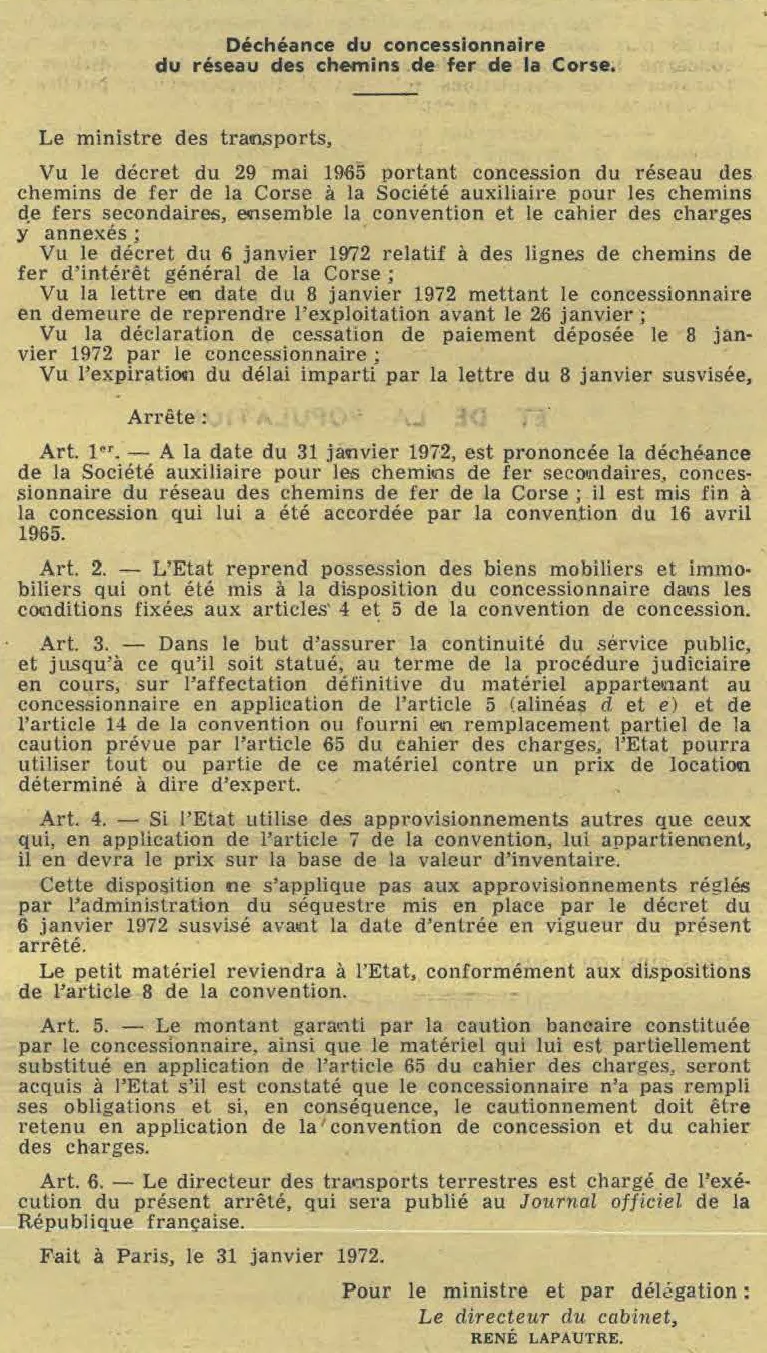
Revocation of the SACFS concession — 1972.
On 31 January 1972, the Minister of Transport revoked the concession held by the operator of the Corsican railway network. Placed under administrative sequestration earlier that month, the network continued to operate under temporary administration.
Journal officiel de la République française, arrêté du 31 janvier 1972, publié le 2 février 1972.
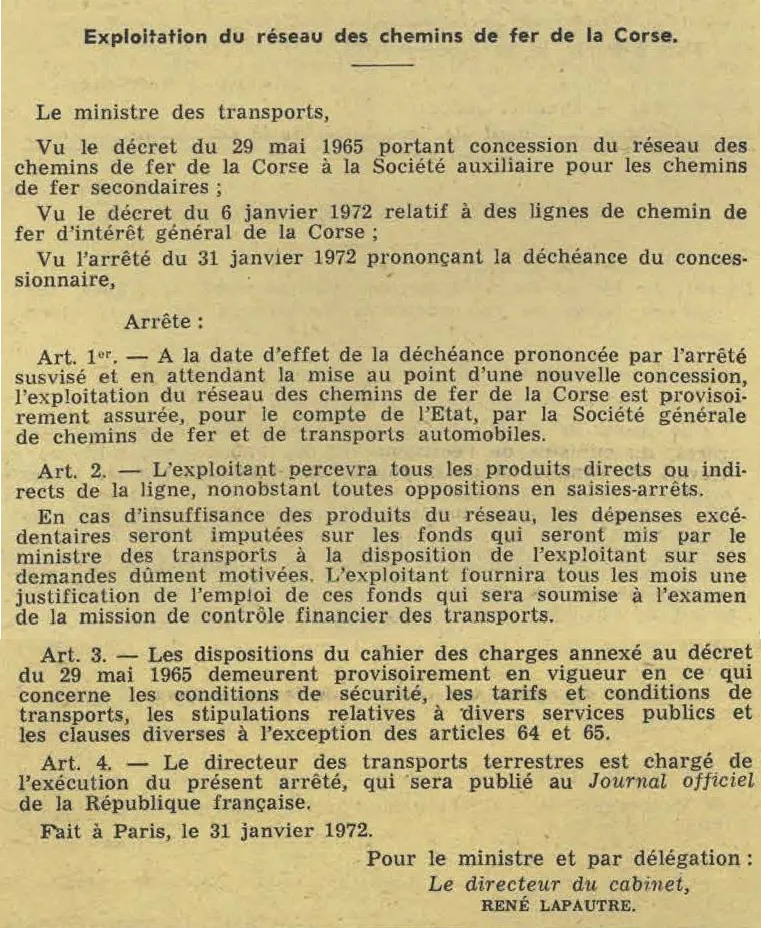
A new operator on behalf of the State — 1972.
A second order dated 31 January 1972 provisionally entrusted operation of the network, on behalf of the State, to the Société générale de chemins de fer et de transports automobiles.
Journal officiel de la République française, 2 février 1972.
The arrival of the “two-thousands”.
On 27 July 1975, X 1201 emerged from the hold of the Monte-Rotondo in Bastia. For the first time in more than twenty-five years, the Corsican railways received a new railcar. Its arrival marked the start of the fleet renewal undertaken under the new operating arrangements introduced after the 1972 crisis.
Built at CFD's Montmirail works, five new railcars were delivered between 1975 and 1976. Three initially had a first-class compartment and were numbered X 1201, X 1202 and X 1204; the other two, with second-class seating only, were numbered X 2003 and X 2005. Following the abolition of first class, the entire series would be renumbered X 2001 to X 2005.
Able to run in multiple and of a much more modern design than the older Renault and Billard railcars, the “two-thousands” symbolised the network's renewal in the 1970s. However, bringing them into reliable operation proved difficult: poor adhesion and the vulnerability of some mechanical equipment beneath the body soon caused operating problems, particularly on the steep gradients of the central line.
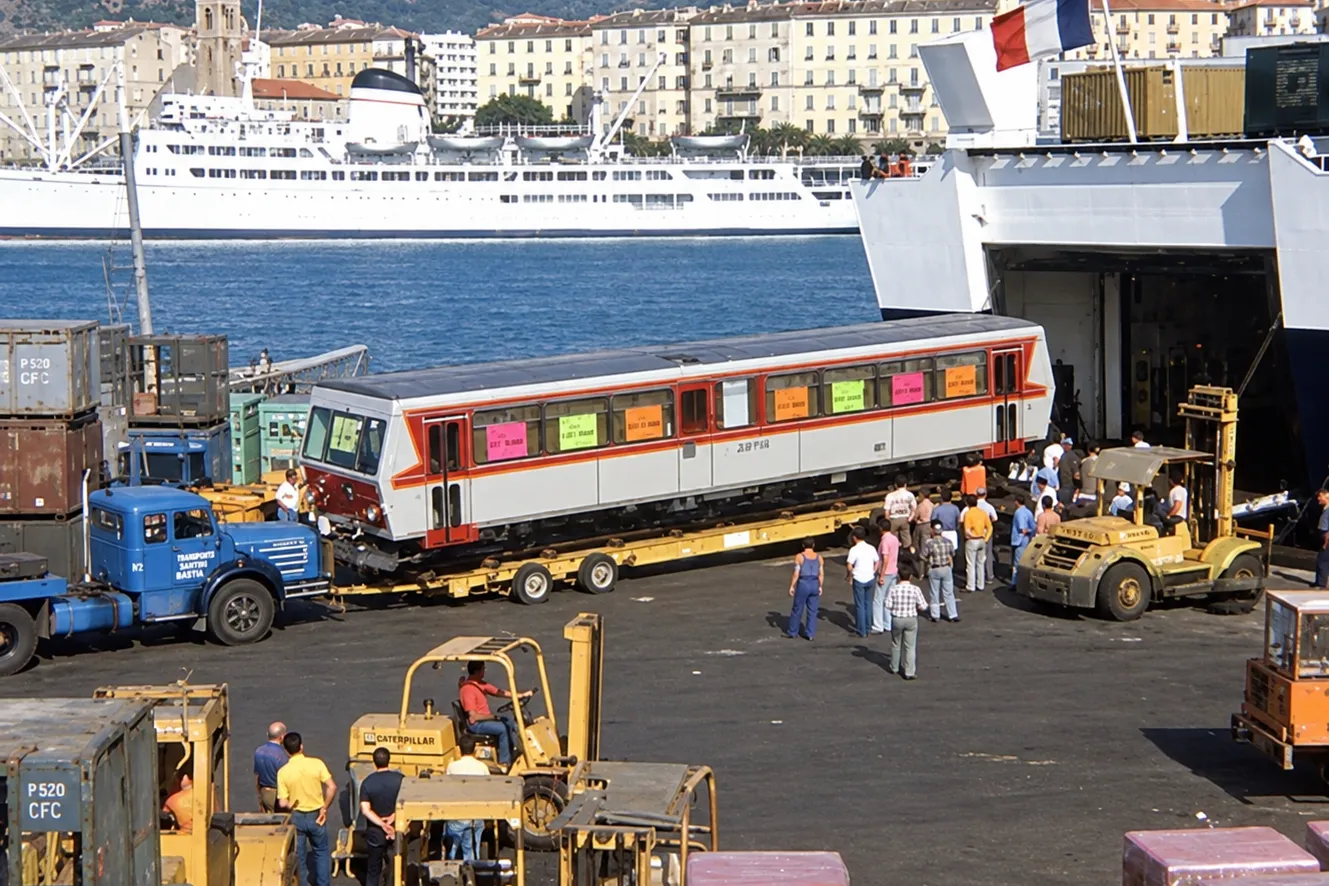
The first “two-thousand” arrives in Corsica — 27 July 1975.
X 1201 emerges from the hold of the Monte-Rotondo in Bastia. It is the first of five new railcars delivered to the network between 1975 and 1976.
Photograph: Raymond Duton.
The Vecchio becomes protected heritage.
On 29 July 1976, the Vecchio railway viaduct was listed as a Monument historique. Built between Venaco and Vivario to carry the central line across the deep Vecchio gorge, it has become one of the most spectacular symbols of the Corsican network.
Its metal deck measures 140 metres, within an overall length of 170.96 metres, and crosses the Vecchio about 84 metres above the river. More than eighty years after its construction, this protection recognised the heritage value of one of the great engineering structures on the Bastia–Ajaccio line.
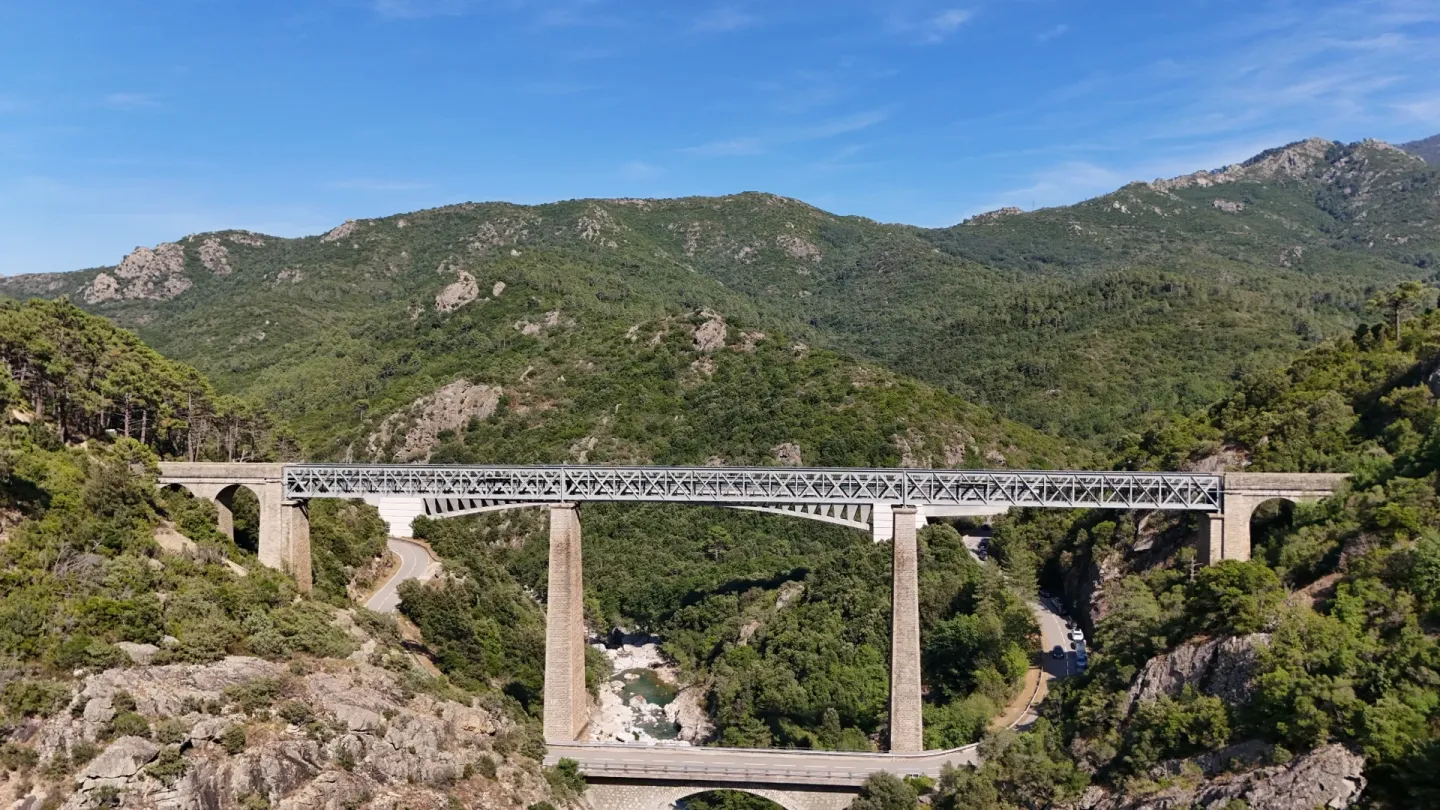
The Vecchio viaduct today
A contemporary view of the viaduct, listed as a Monument historique on 29 July 1976.
Photograph taken on 10 August 2024 — Pedro Navarro.
Casamozza becomes the maintenance hub.
On 9 June 1978, the new Corsican railway workshops at Casamozza were inaugurated during President Valéry Giscard d'Estaing's visit to the island. Their construction accompanied a period of network renewal: a new agreement between the State and the CFTA had been in place since 1977, providing in particular for further deliveries of new railcars and the renewal of 104 kilometres of track.
The transfer moved the main maintenance activities from Bastia to Casamozza. The former junction station for the east coast line had enough space to accommodate the new technical centre. Two specialised buildings were provided: a lifting workshop, particularly for powered rolling stock, and a carriage and wagon workshop for bodywork and hauled vehicles. Casamozza thus became the network's main maintenance centre.

Casamozza prepares for the new workshops — 1976.
Near Casamozza station, the sawmill is demolished and the ground prepared for the future Corsican railway workshops, inaugurated in June 1978.
Photograph: Raymond Duton, 1976 — source: VoieEtroite.org.
The X 5000 gain better adhesion.
Following the limitations encountered with the X 2000, a new generation of railcars appeared on the network. Ordered in 1980, the two X 5000 followed the same general design but benefited from more powerful engines and, above all, four powered axles. X 5001 left CFD's Montmirail works in October 1981 before being tested on the Blanc-Argent railway; X 5002 subsequently completed the series.
Heavier and more powerful than their predecessors, the X 5000 had much better adhesion. Their two engines each developed approximately 240 hp, enabling them in particular to haul trailers XR 104 and 105, a task for which the X 2000 had proved inadequate. Their arrival completed the fleet renewal begun in the mid-1970s.
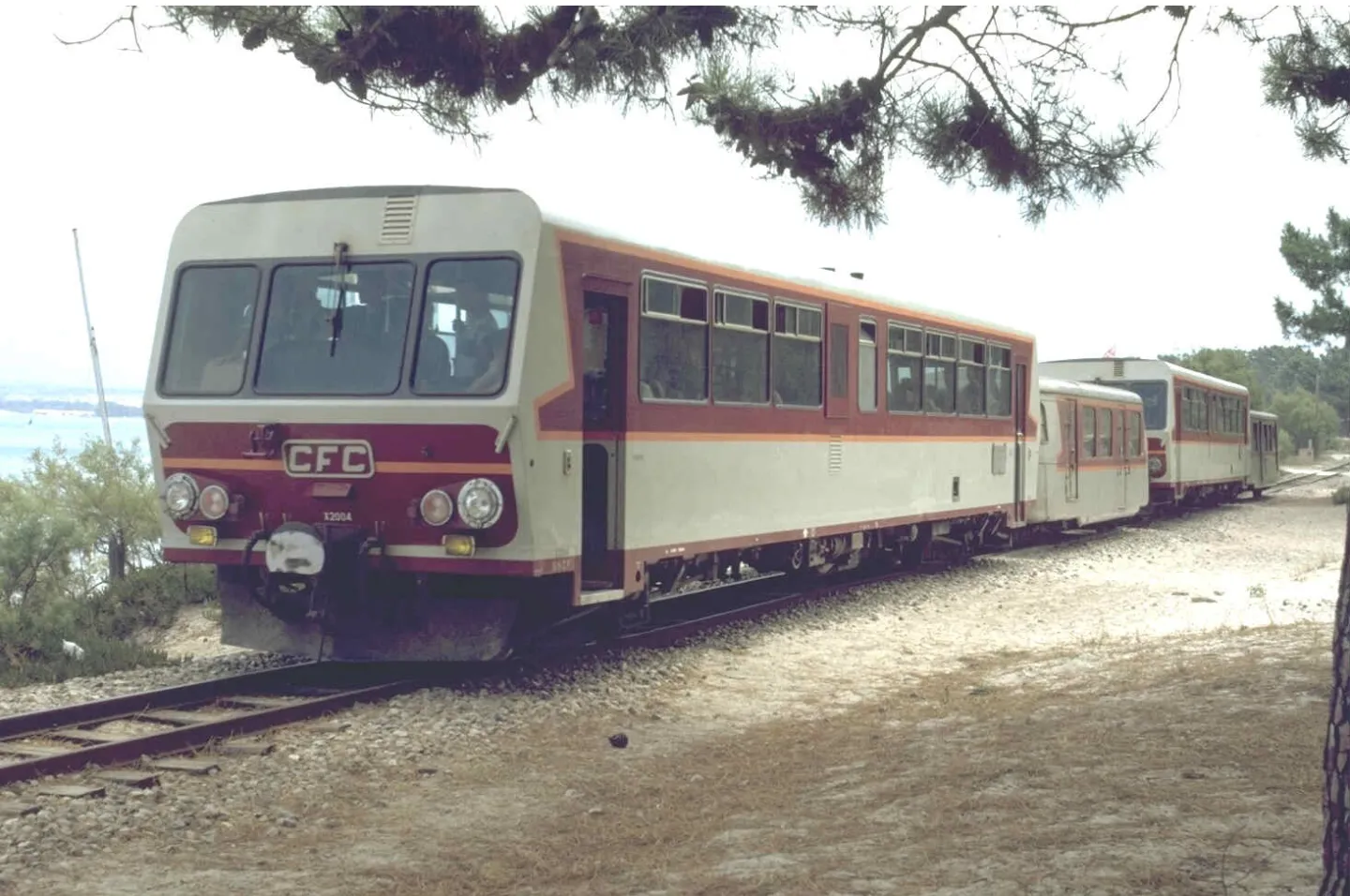
A summer train runs beside Calvi beach — 24 July 1986
Arriving from Bastia, a four-vehicle train, the maximum formation used at the height of the summer season, runs alongside the beach as it approaches Calvi late in the morning of Thursday 24 July 1986.
Credit: Collection Luc Beaumadier · traincorse.free.fr.
The SNCF takes charge
On 1 January 1983, the SNCF took over operation of the Corsican railway from the CFTA at the State's request. The decision had been prepared in late 1982: after the agreement with the CFTA was terminated on 24 December, a ministerial letter dated 29 December instructed the SNCF to operate services provisionally.
A further milestone came on 1 July 1983, when responsibility for rail transport was transferred to the Region of Corsica. The Region now took over the State's rights and obligations concerning operation of the network, while the SNCF remained the operator.

The operating takeover dates to 1983. The ministerial steps of December 1982 precede it.
The railway bypasses Biguglia's level crossings
The widening of the RN 193 profoundly changed the railway south of Bastia. Previously, the track crossed the national road twice within just 3.5 km, at Casatorra and near the present-day Tragone stop. With increasing road traffic, these two level crossings became particularly restrictive.
Between 1982 and early 1984, the railway was completely realigned along this section. The new track now ran along the eastern side of the road, allowing both level crossings to be removed. The scheme also included a new bridge over the Bevinco and a new Biguglia station. The old station, on the other side of the national road, disappeared as the new neighbourhood developed. Casatorra stop was created near its former site.
This was one of the largest changes to the route of the Bastia–Ajaccio line since it opened.
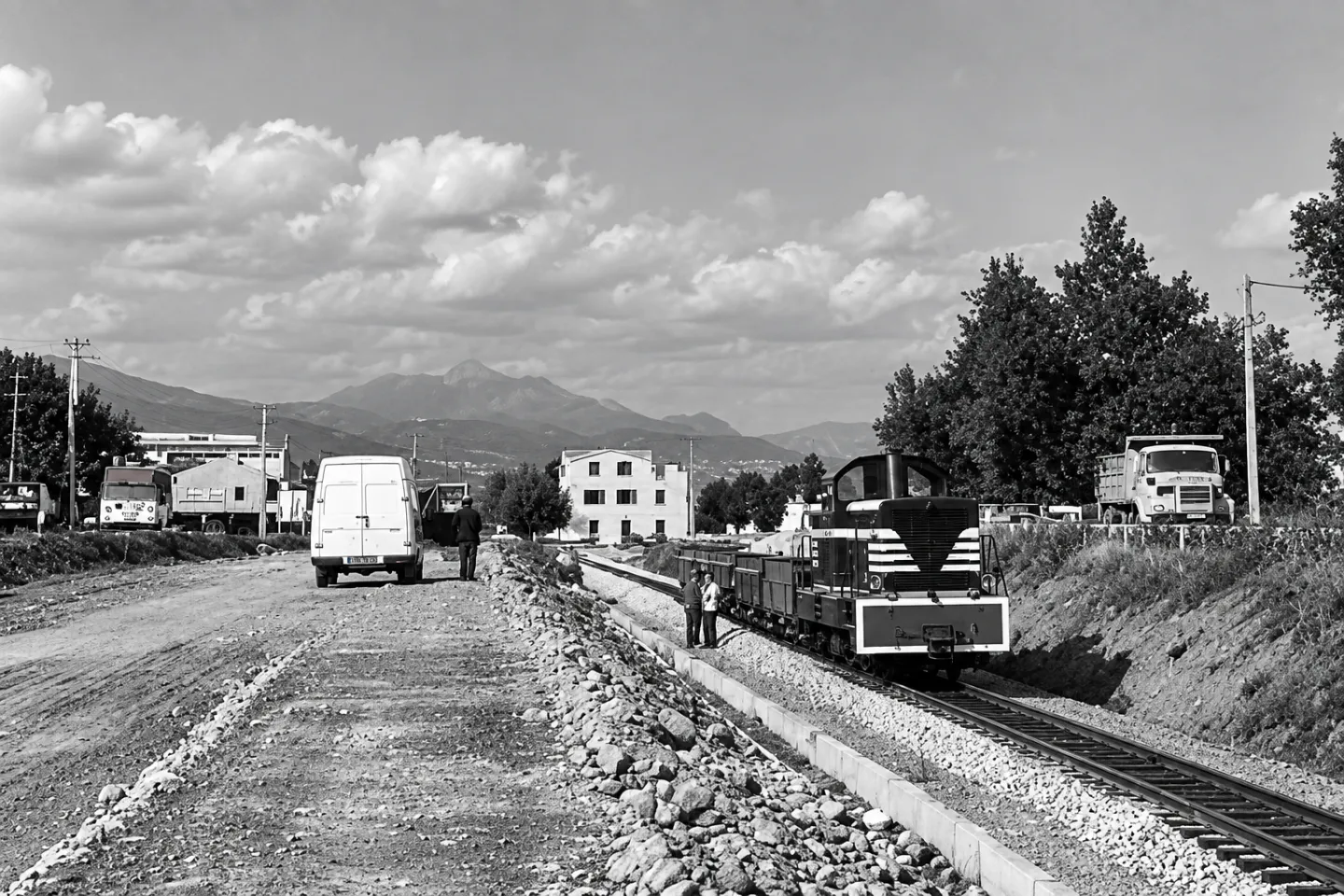
Construction of the new railway alignment at Biguglia — 1982–1984
As part of the widening of the RN 193 to a dual carriageway, approximately 3.5 km of railway is moved to the east of the road. The works allow the Casatorra and Tragone level crossings to be removed and include a new Biguglia station.
Photograph: Pascal Béjui — Collection Cercle Ferroviaire Corse.
The Soulé units open a new era.
Faced with rising passenger numbers, particularly during the summer season, and intensive use of the X 2000 and X 5000, the network embarked on a further renewal of its rolling stock. A first order was placed in 1988 with Soulé of Bagnères-de-Bigorre.
On 4 April 1989, the first Soulé set, comprising powered railcar X 97051 and trailer XR 9701, was unloaded at Bastia station. It introduced a new generation of rolling stock to the Corsican network. More modern and comfortable than earlier generations, it offered a smoother ride and greater reliability. Two further sets from the first batch also joined the network in 1989.
The X 97050 were designed to operate with a driving trailer and could be coupled to form higher-capacity trains. Their arrival gradually modernised Bastia–Ajaccio services. Two more railcars strengthened this new generation in 1992.
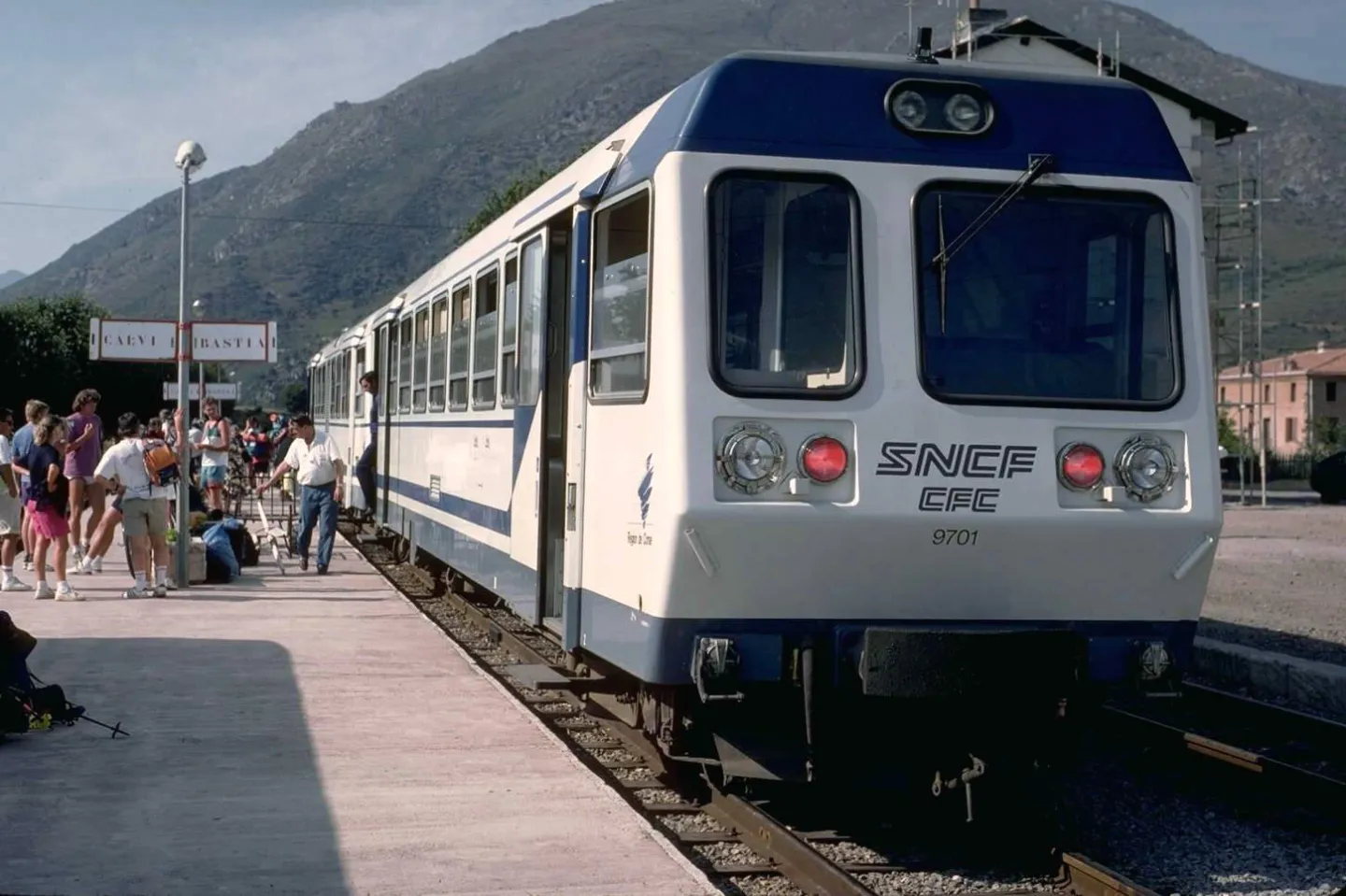
The first Soulé set on the central line.
Powered railcar X 97051 and its trailer XR 9701, the first of their series to arrive in Corsica in 1989, work an Ajaccio–Bastia train at Ponte-Leccia on 8 July 1991.
Photograph: Luc Beaumadier, 8 July 1991 — Collection Luc Beaumadier / traincorse.free.fr.
Two extra power cars for the Soulé family.
In 1997, X 97056 and X 97057 joined the Corsican network. Built by CFD Bagnères, which had taken over Soulé's railway business, these two new powered railcars extended the X 97050 family introduced in 1989, with more powerful engines. Only one new trailer, XR 9706, accompanied the order. The fleet now comprised seven powered railcars and six trailers.
This increase in the fleet supported the expansion of services. That same year, demand and the greater availability of railcars allowed an additional Corte–Bastia return service to be restored, strengthening services on the central line.
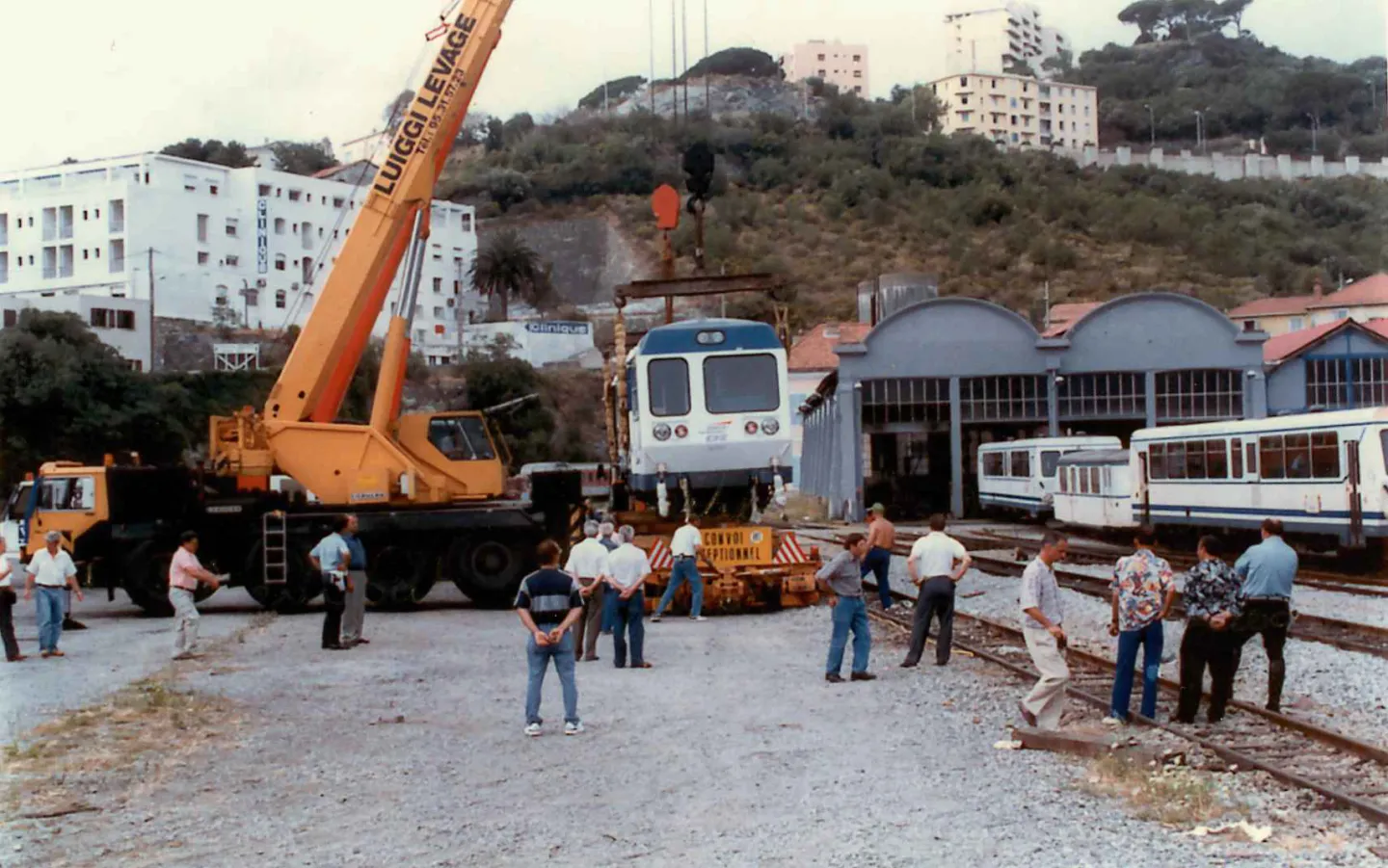
The final X 97050 arrive in Corsica — 1997.
Unloading at Bastia station of one of the two new powered railcars X 97056 or X 97057, built by CFD Bagnères to complete the X 97050 family.
Photograph: collection Jean Melero — document published on Luc Beaumadier's website, traincorse.free.fr.
A network belonging to Corsica.
The Collectivité territoriale de Corse became the owner of the railway network. Already responsible for organising rail transport, it now controlled its assets, development, maintenance and management. This was a major step towards local control of the railway.
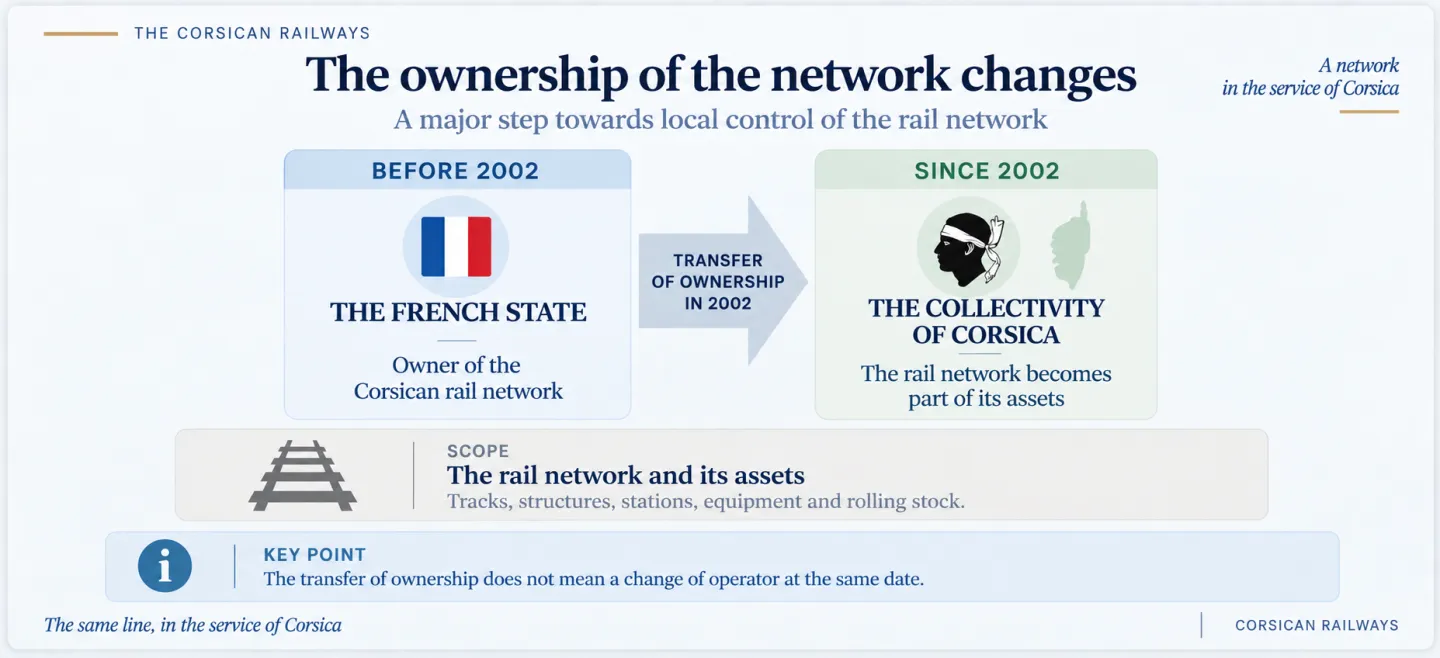
Transfer of ownership; this does not mean the operator changes on the same date.
Renewing the track.
Two years after becoming the owner of the railway network, the Collectivité territoriale de Corse launched major track renewal works in 2004 and 2005. Surveys carried out in 2002 and 2004 had highlighted the infrastructure's poor condition, with broken rails, derailments and numerous sections restricted to 20 or 40 km/h.
A major track and ballast renewal programme (RVB) was launched. Rails, sleepers and ballast were replaced over long sections of the network. Substantial railway resources were shipped to Corsica for the works: twelve Romanian locomotives took part, with works trains often operated by two locomotives coupled together.
The programme continued for several years. By its completion in June 2010, 172 km of the network's 232 km of track had been renewed, approximately 74% of the network. This upgrading was one of the largest infrastructure renovation campaigns since the lines were built and prepared the way for the profound modernisation of operations that followed.
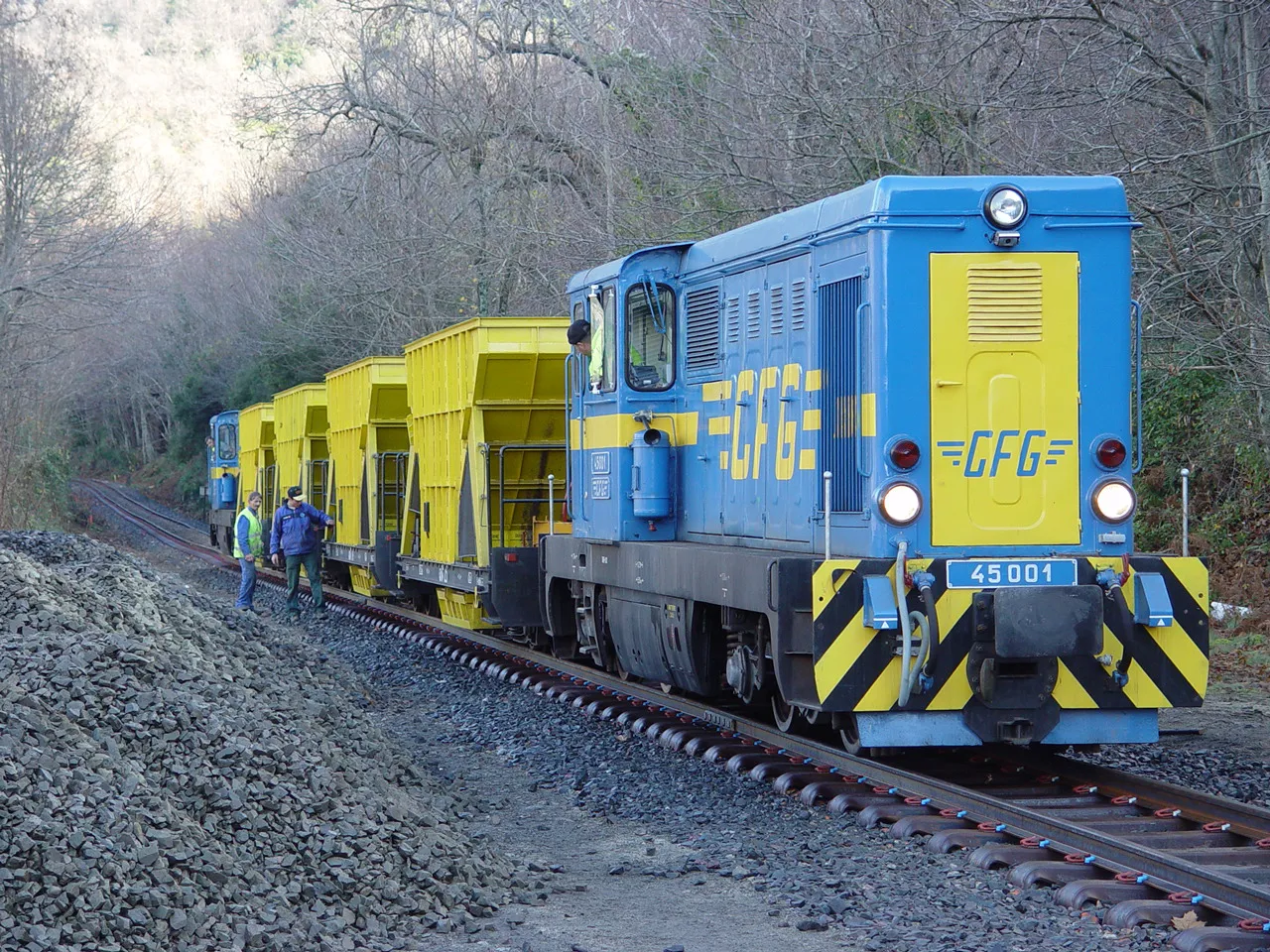
Major track renewal works — 2004.
Locomotive 45 001 and its ballast wagons take part in track and ballast renewal on the Corsican network. It is one of the first Romanian locomotives shipped to the island for the major infrastructure modernisation works.
Photograph: Pedro Navarro, 14 December 2004.
The first AMG 800 sets its wheels on Corsica.
Ordered by the Collectivité territoriale de Corse to renew the fleet comprehensively, a new generation of railcars appeared on the network. On 23 June 2007, the two cars of the first AMG 801/802 set arrived in Ajaccio after crossing from Marseille. Transported separately, they were unloaded, placed on the rails and coupled together that day to form the Corsican network's first AMG 800 set.
On 2 July, it made its first run towards Mezzana: this marked the start of testing, still separate from passenger service. It was the beginning of a long campaign to validate this entirely new rolling stock against the particular characteristics of the Corsican network. This was not yet the start of passenger service: testing would reveal several technical difficulties and delay commercial operation. The first sets would not enter regular service until 2009.
The AMG 800 were designed specifically for Corsica. Air-conditioned, accessible to people with reduced mobility and fitted with large panoramic windows, they were intended ultimately to bring major improvements in comfort and performance on the central line.
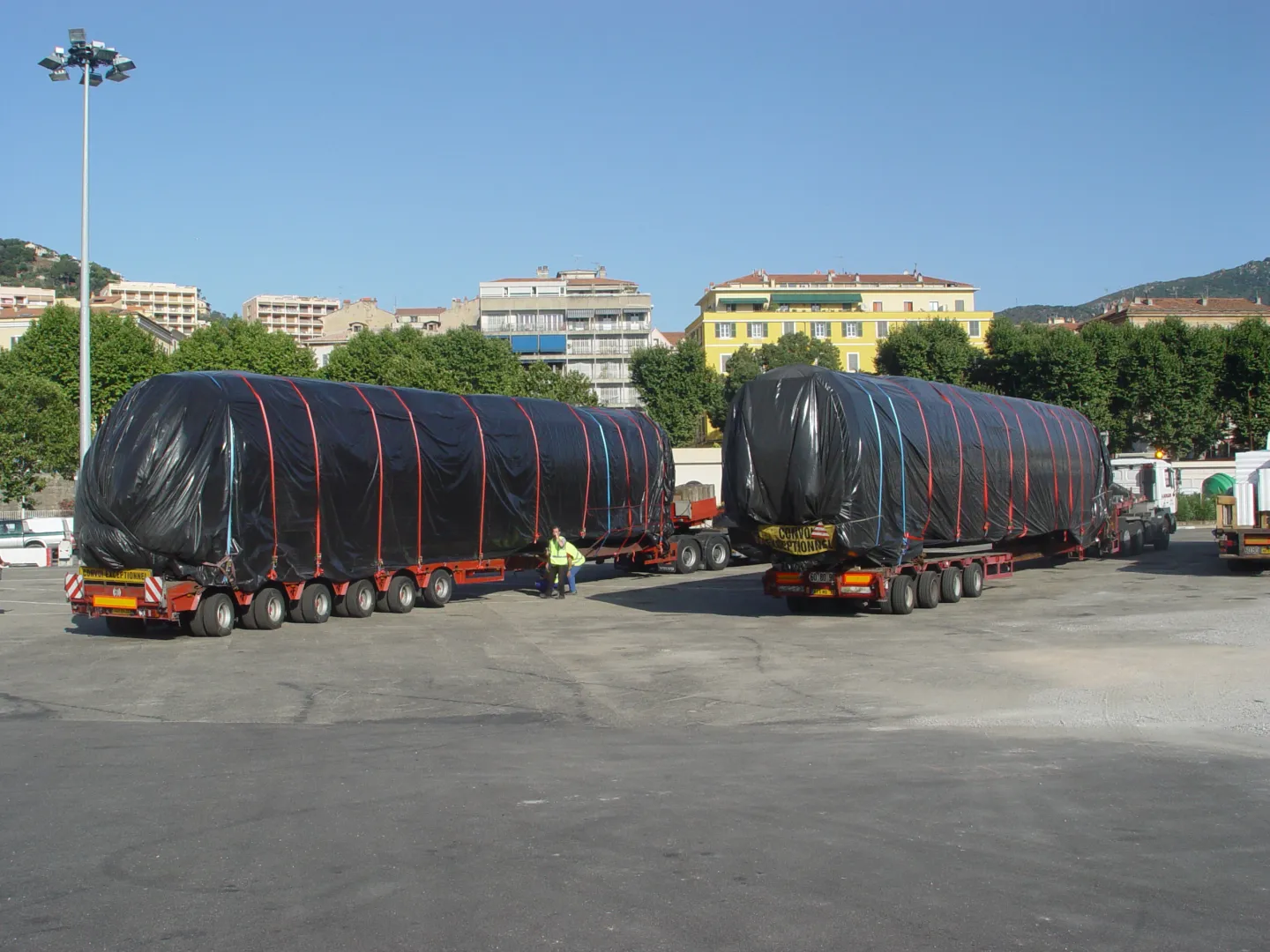
Arrival of the first AMG 800 in Ajaccio — 23 June 2007.
The two cars of AMG 801/802, still protected for transport, await placement on the rails. They will be coupled together that day to form the Corsican network's first AMG 800 set.
Photograph: Pedro Navarro, 23 June 2007.
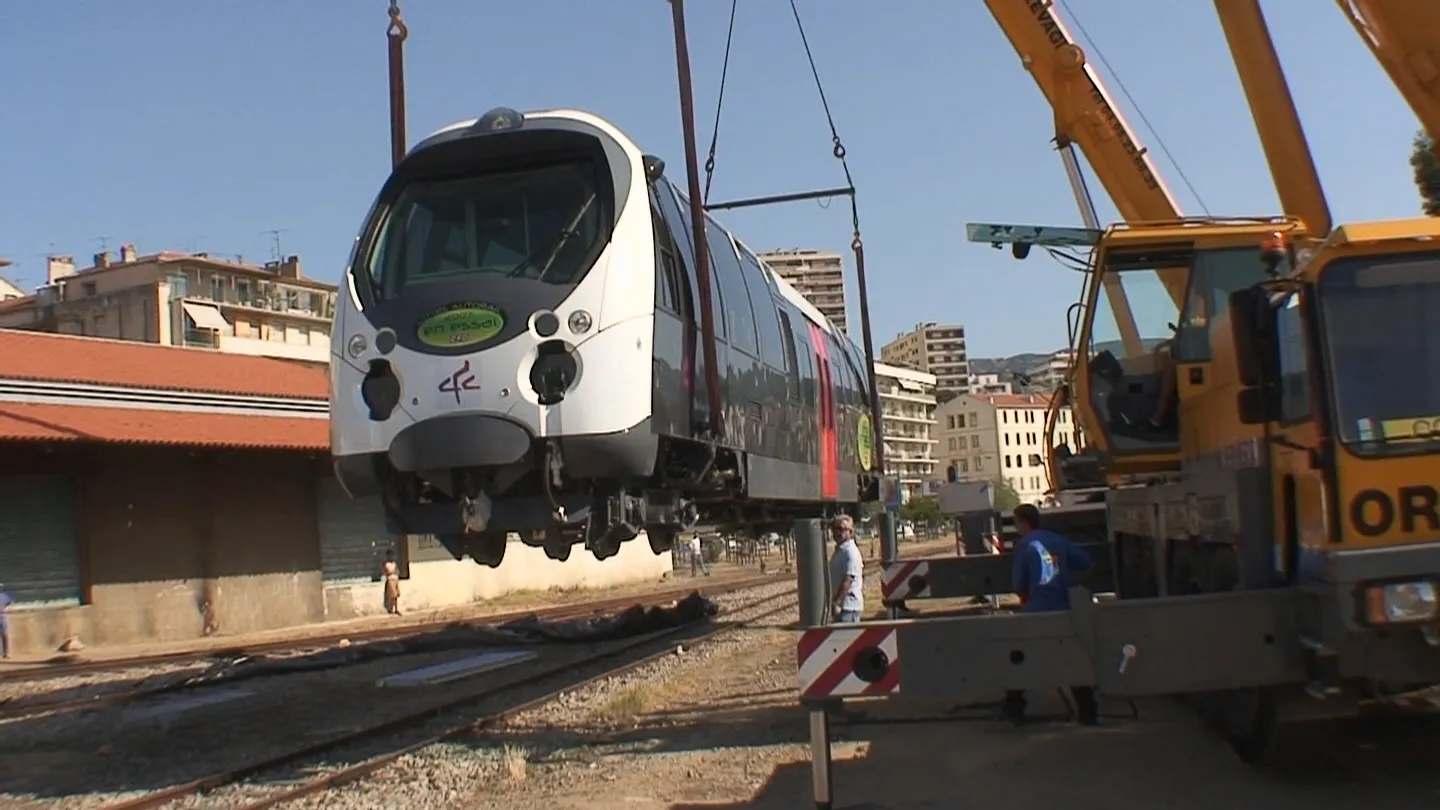
Placing the first AMG 800 on the rails — 23 June 2007.
AMG 801 is lifted before being lowered onto the tracks in Ajaccio and coupled to the other car of the set.
Photograph: Pedro Navarro, 23 June 2007.
The first centralised single-track control for Bastia’s suburban service.
In November 2008, the first centralised single-track control system (CCVU) entered service on the Bastia–Casamozza section. Its operation was authorised from 23 November 2008. It covered five stations: Bastia, Furiani, Biguglia, Borgo and Casamozza, on the part of the network carrying most of Bastia's suburban traffic.
Its commissioning marked a profound change in train control. Until then, single-track operation had relied largely on human procedures to arrange crossings and ensure that only one train occupied a given section. With CCVU, routes, points and signalling were controlled centrally by computer. The operator thus had an overview of the section and could arrange crossings from a central control post.
Above all, CCVU made an essential contribution to safety. The system checked the conditions required to set routes and interlocked the equipment: a route conflicting with an already authorised movement could not be set. Points and signals were integrated into a safety chain designed to prevent incompatible movements and the risk of two trains meeting on the single track.
This enhanced safety also enabled more efficient operation. Crossings could be arranged more flexibly and the section's capacity increased, supporting the development of Bastia's suburban services. Ten years later, in 2018, the president of the Corsican railways highlighted the importance of these services, referring at the time to 48 daily rotations between Bastia and Casamozza and 52 between Bastia and Furiani.
The 2008 CCVU was thus a decisive step, combining safe train movements, centralised operation and increased single-track capacity. It foreshadowed the much broader modernisation of control and signalling that would subsequently be undertaken across the rest of the network.
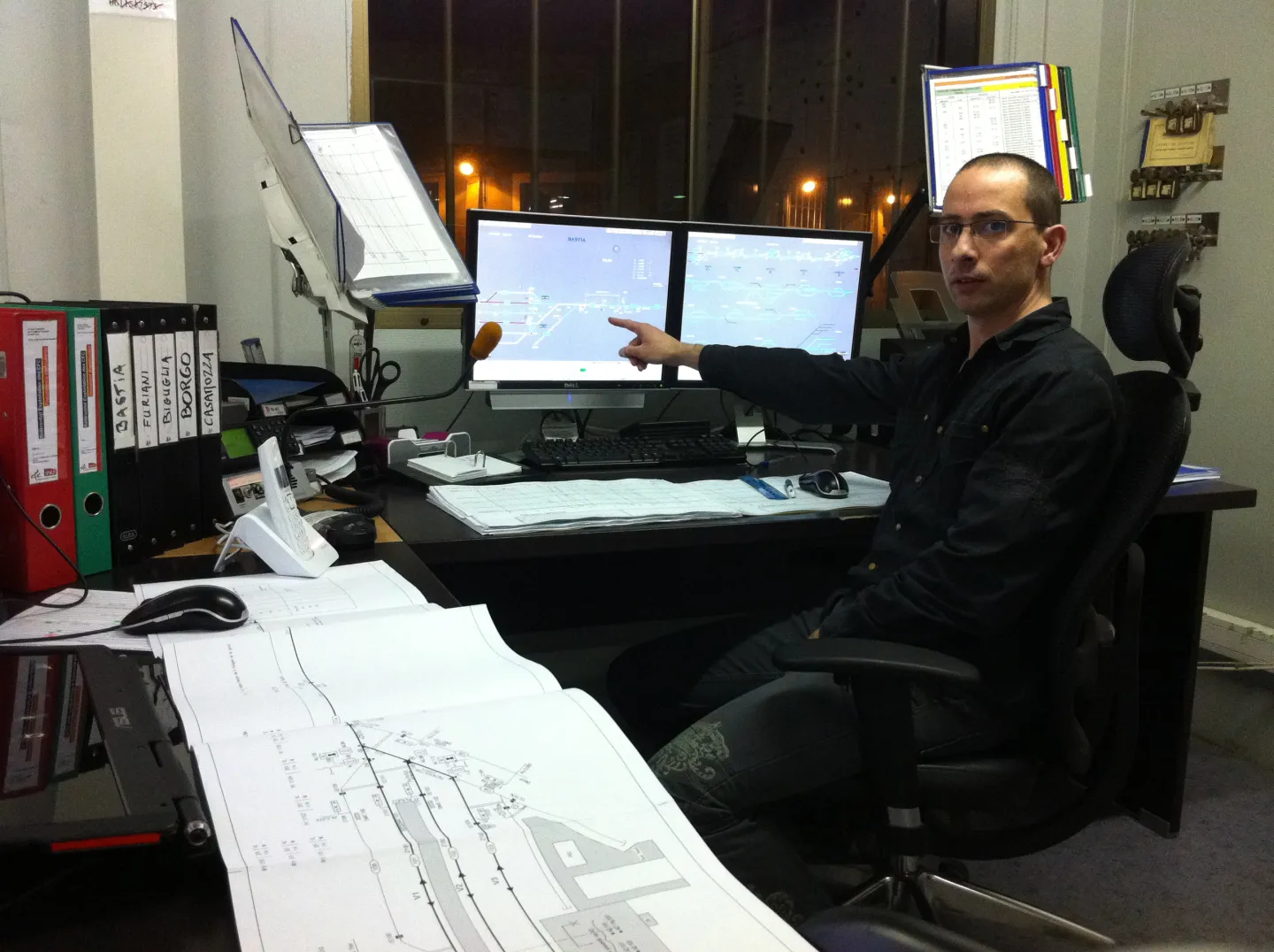
The control post for the first CCVU in Bastia
The control and signalling screens of the centralised single-track control system (CCVU), commissioned on 23 November 2008 on the Bastia–Casamozza section. This installation marked a major advance in managing train movements, securing routes and organising crossings on Bastia's suburban network.
Credit: Pedro Navarro.
The first AMG units enter service.
After almost two years of testing and development, the AMG 800 were authorised to carry passengers from 29 March 2009. This initial authorisation covered single-unit operation on the Bastia–Ajaccio line, with a maximum speed set at 100 km/h.
Their entry into commercial service marked a new stage in the network's modernisation. More spacious, air-conditioned, accessible to people with reduced mobility and fitted with large panoramic windows, the AMG 800 brought major improvements in comfort and performance compared with earlier generations.
From 30 March, their introduction accompanied changes to services: four daily trains provided a non-stop Bastia–Casamozza express link in 19 minutes, while two additional return services strengthened Bastia's suburban network. A new daily Ajaccio–Vizzavona service was also introduced.
The different stages in this generation's history must nevertheless be distinguished: 2007 marked the arrival of the first AMG 800 in Corsica and the start of testing; 2009 saw the first commercial services; and only in 2013 did the fleet reach the planned twelve sets. This first period of operation would nonetheless be interrupted: technical difficulties led to the AMG fleet being withdrawn from service in February 2010, before a further phase of development.

Casamozza workshops enter a new era
Launched to support the renewal of the rolling stock, the renovation and extension of the Casamozza workshops marked another stage in modernising the Corsican railways. Built in 1978, the original workshops needed to be adapted in particular to maintain the AMG 800, whose two-car units required larger facilities than the older railcars.
The project, whose main contract was awarded in June 2008, covered maintenance tracks and inspection pits, industrial buildings, stabling areas and specialised maintenance equipment. It included new lifting facilities and equipment suited to modern railcars.
However, the works were delayed and carried out in several phases. Partial handovers took place in December 2010 and December 2011, allowing maintenance activities to continue. The final outstanding defects were not cleared until September 2013.
This modernisation brought lasting changes to Casamozza, which retained its role as the network's main technical centre and gradually acquired facilities better suited to maintaining newer generations of railcars.
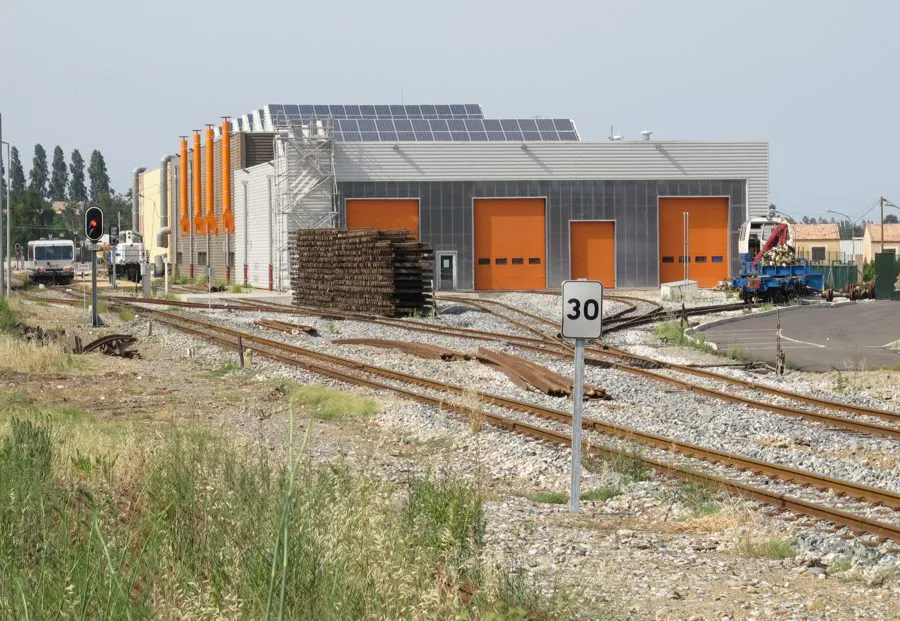
Casamozza workshops during renovation — 13 July 2011
Renovation and modernisation works at the Casamozza workshops, intended in particular to adapt the maintenance facilities to the new AMG 800 units.
Photograph: Luc Beaumadier, Wednesday 13 July 2011 — traincorse.free.fr.
A mixed-economy company to operate the network.
After almost thirty years of operation by the SNCF, a new period began for the Corsican railway. Following the decision taken by the Corsican Assembly on 16 December 2011, operation of the network was entrusted to a newly created mixed-economy company: SAEML Chemins de fer de la Corse. The Collectivité, already the network's owner since 2002, now had its own railway operator.
This new organisation emerged as the AMG 800 gradually returned to the network. Following their withdrawal from service and major reliability improvements undertaken in 2011, four sets had resumed service by the end of that year. Eight AMG were available in summer 2012, enabling a substantial increase in services.
Deliveries also resumed. Several new AMG arrived in Corsica during the summer: the tenth set was unloaded in Ajaccio in August, and the final two were then expected before the end of the year. The photograph taken at Vizzavona on 29 October 2012 shows the new AMG 821/822 during testing, in this final delivery phase.
The growing fleet also allowed services to be expanded. In summer 2012, the CFC offered notably 12 Bastia–Casamozza return services, 10 Ajaccio–Mezzana, four Ajaccio–Corte and six Calvi–L'Île-Rousse. Services were strengthened further at the start of the academic year, and a service for students was introduced.
Thus 2012 marked a change of operator, the strong return of the AMG 800 and a new phase in the development of Corsican rail services.
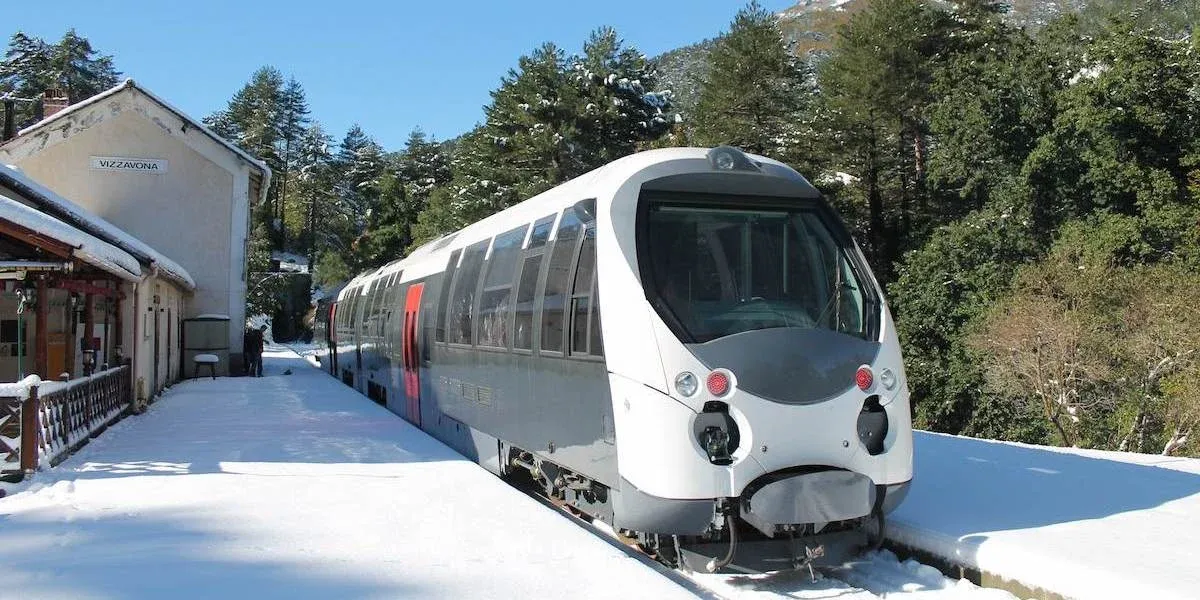
An AMG 800 in the snow at Vizzavona — 2012.
AMG 821/822, delivered new a few weeks earlier, stops at Vizzavona station during its testing programme before continuing towards Ajaccio. The series, whose first sets entered commercial service in 2009, will reach twelve sets in 2013.
Photograph: L.F.F., 29 October 2012.
All twelve AMG units are here; Balagne welcomes them.
On 2 February 2013, the twelfth and final AMG 800, numbered 823/824, arrived in Ajaccio. Its delivery completed the fleet renewal begun in 2007, after several years marked by technical difficulties and a lengthy reliability improvement programme. The network now had twelve two-car sets, or 24 cars in total.
A further milestone was reached on the Ponte-Leccia–Calvi line. Until then, the AMG 800 had not operated regular commercial services there, notably because of clearance restrictions around L'Île-Rousse. Widening work on the cutting prepared for their arrival. Clearance tests were then carried out to check that these railcars, larger than previous generations, could pass safely.
On 17 June 2013, AMG 815/816 inaugurated commercial service for this generation on the Balagne line. The AMG could now serve the Corsican network's three main branches: Bastia–Ajaccio, Ponte-Leccia–Calvi and Bastia's suburban services. This extension accompanied the gradual improvement of services and passenger comfort.
With a complete fleet and a largely renovated network, the Corsican railways now had modern rolling stock capable of meeting the needs of both intercity services and everyday travel.
The railway passes one million passengers
In 2014, the Corsican railways passed the symbolic threshold of one million annual passengers for the first time, recording approximately 1.028 million journeys. Passenger numbers rose by 24% compared with 2013 and by 64% since 2011, reflecting the revival of rail transport on the island.
This growth accompanied the return to service of the AMG 800, infrastructure modernisation and expanded services. The train was playing an increasing role in everyday travel, particularly around Bastia and Ajaccio, where suburban services offered an alternative to road traffic.
This symbolic milestone confirmed the benefits of investment undertaken since the early 2000s and marked a new phase of development for the Corsican network.

Renovation begins on major structures
In 2018, the Collectivité de Corse continued to modernise the railway network, paying particular attention to the preservation of its historic engineering structures. Renovation programmes covered the Vecchio viaduct, several railway tunnels and five metal structures between Ponte-Leccia and Casamozza.
These works aimed to extend the life of the infrastructure, improve operational safety and preserve structures, some over a century old, that were essential to the continuity of the network.
Meanwhile, a further transformation of operations was being prepared. On 29 June 2018, the Corsican Assembly adopted the plan to deploy centralised single-track control (CCVU) throughout the railway network. Studies continued with a view to extending the system beyond the Bastia–Casamozza section, equipped since 2008.
This decision was a decisive step towards network-wide centralised control, intended to improve train safety, manage crossings more effectively and increase the Corsican railway's operating capacity.
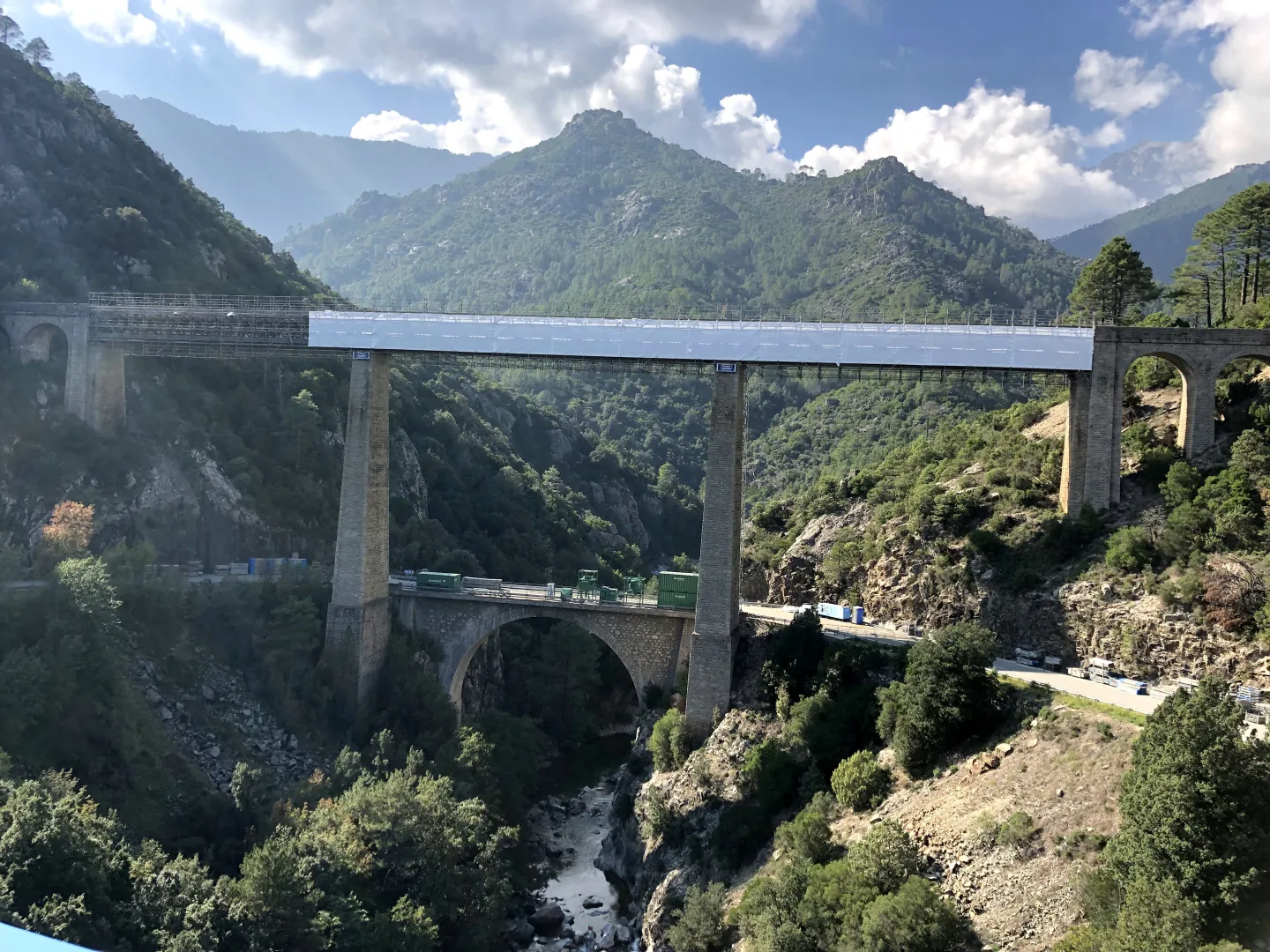
Renovation of the Vecchio viaduct — 2019
An overall view of the Vecchio viaduct, with its metal structure surrounded by scaffolding and protective coverings during restoration work.
Photograph: Pedro Navarro, 2 March 2019.
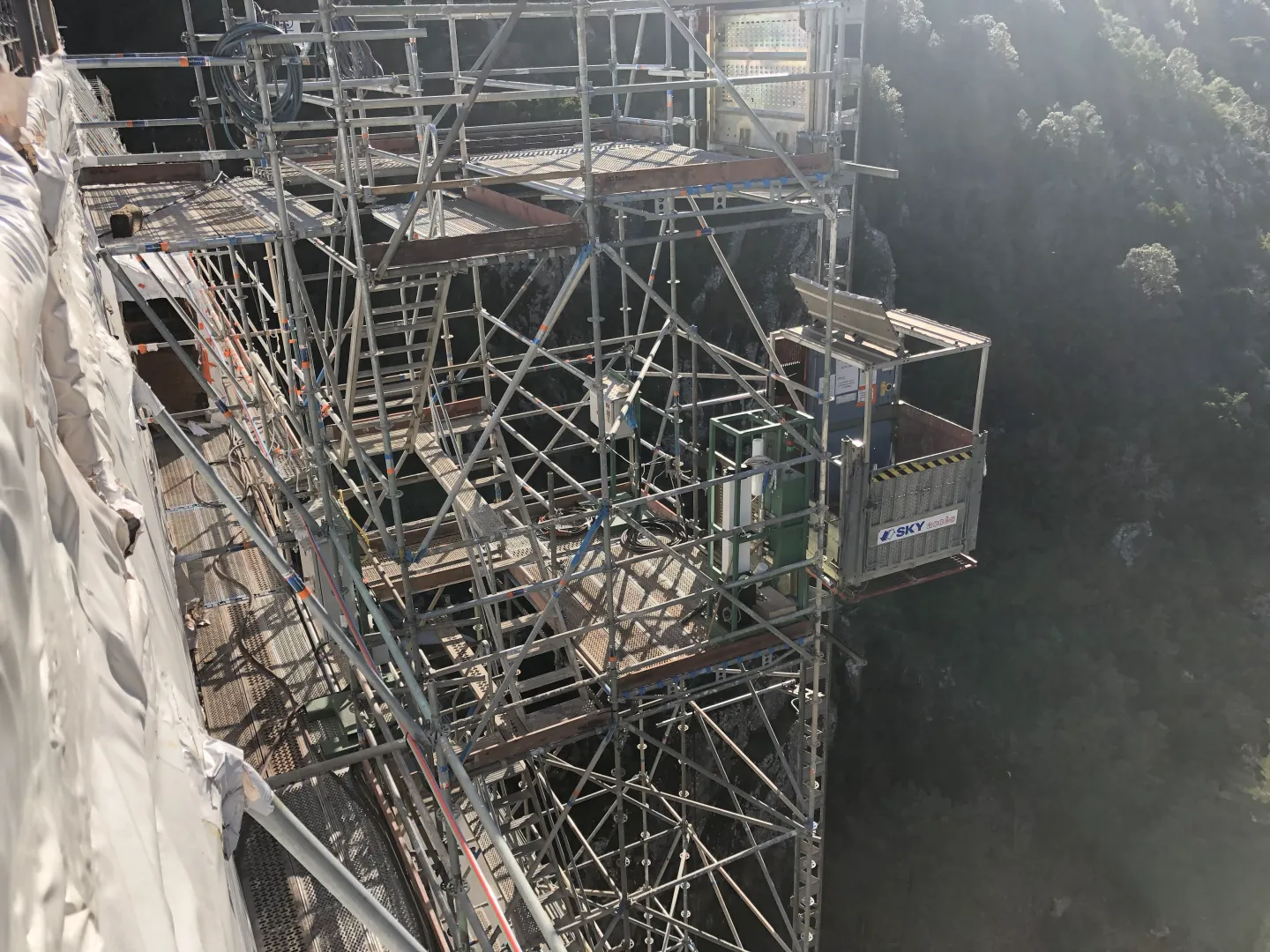
An exceptional worksite above the Vecchio — 2019
Suspended scaffolding and a working platform installed on the viaduct's metal structure for renovation works, several tens of metres above the valley.
Photograph: Pedro Navarro, 2 March 2019.
Bastia’s historic depot faces demolition
In 2019, a further step was taken in reorganising Bastia's railway facilities. On 25 April, the Corsican Assembly approved the plan to transfer the railway depot to Casamozza, bringing maintenance activities together on a site better suited to the network's needs. Estimated at €4.2 million, the operation formed part of a wider redevelopment of railway land in Bastia.
The decision meant the planned disappearance of the old sheds and workshops at Bastia depot, witnesses to several generations of railway operations. Their demolition would free up land for redevelopment around the station, including new urban amenities, parking areas and buildings.
On 1 December 2019, the depot ceased to be used. Its buildings, some in an advanced state of deterioration, were then scheduled for demolition during 2020. Their disappearance marked the end of a historic rolling-stock stabling and maintenance site, while the Casamozza facilities were intended to accommodate the transferred activities.
This reorganisation continued a process begun in 1978, when the network's main workshops moved from Bastia to Casamozza. It marked a further stage in concentrating technical resources and transforming Bastia's railway land.

The maintenance facilities at Casamozza
Credit: Photograph: Pedro Navarro.
Operations pass to an EPIC.
On 1 January 2024, a new chapter opened in the organisation of the Corsican railways. After twelve years operating as a local mixed-economy company (SAEML), management and operation of the network were taken over by a public industrial and commercial establishment (EPIC) named U Caminu di Ferru di a Corsica.
Decided by the Corsican Assembly on 31 March 2023, this transformation marked a move to direct public management through a body with its own legal personality and financial autonomy. As owner of the network, the Collectivité de Corse thereby strengthened its control over the organisation and development of the railway service.
The change primarily concerned the legal structure and the way operations were managed. Trains continued running on the same network, while the new establishment took over from the SAEML to provide the public railway service.

The change in operating structure, confirmed in the Corsican Assembly’s report.
New centralised control for the network.
On 3 November 2025, the Corsican railways reached a historic milestone with the commissioning of the new centralised single-track control system (CCVU). Seventeen years after the first installation, limited to the Bastia–Casamozza suburban section, centralised control now extended across the entire Corsican railway network. This date is confirmed by the Collectivité de Corse.
The project modernised signalling at 20 stations and was based on a Central Control Post (PCC) in Bastia, backed up by an Emergency Control Post (PCS) in Casamozza. Train movements, routes and crossings were now managed centrally, replacing telephone block working on sections that still used it.
Above all, this transformation represented a major advance in railway safety. The new signalling and control equipment reduced the risks inherent in manual procedures, secured train movements and enabled better control of traffic on the single track.
The modernisation included new crossing points, notably at Bassanese, Ricantu, Caldaniccia, Algajola and Lumio. These installations offered more scope for timetable planning, improved punctuality and the development of suburban services.
The overall investment was announced as €48 million. With this new CCVU, the Corsican network entered a new phase in its history: centralised operation, enhanced safety and new prospects for the development of rail transport on the island.
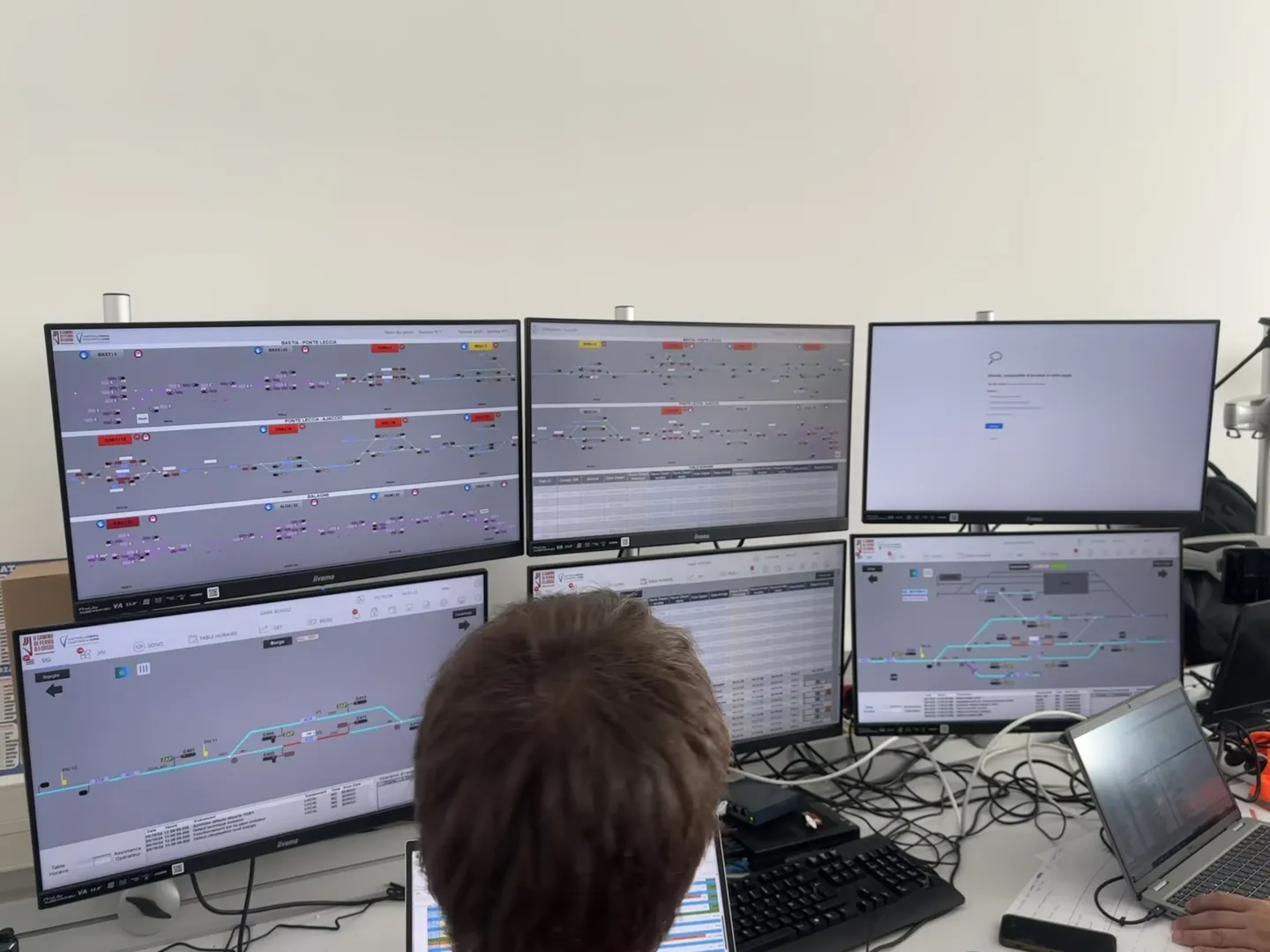
The new CCVU during testing — 5 October 2024
The screens at the new Centralised Control Post (PCC) show the interfaces for supervising train movements, managing routes and controlling signalling equipment during the static tests on 5 October 2024. This verification phase preceded the commissioning of the new CCVU on 3 November 2025, a major transformation in Corsican railway operations.
Photograph: Pedro Navarro, 5 October 2024.
Five major bridges refurbished.
In 2026, a major renovation programme covering five railway bridges reached completion. The works concerned the Casamozza, Prunelli, Albanu, Ascu-Centrale and Muzelle structures, which are essential to the continuity of services on the Corsican network.
These projects formed part of the policy to modernise and preserve railway infrastructure. They aimed to extend the life of the structures, improve their safety and ensure the long-term future of lines whose structures in some cases date back to the network's construction in the late nineteenth century.
Reports submitted to the Corsican Assembly in June 2026 confirmed completion of the programme, but gave two different dates: 30 March 2026 in the report on the AMG 800 and June 2026 in the report on the Ascu-Balagna bridge. The documents do not explain this discrepancy.
This renovation campaign must be distinguished from the new programme of works on the Ascu-Balagna bridge, approved on 26 June 2026, which is a separate project.

Reports 2026/E4/131 (p. 2) and 2026/E4/129 (p. 2) give different completion dates: 30 March and June 2026. No reason for the discrepancy is specified.
Four investments to prepare for the future
On 26 June 2026, the Corsican Assembly approved four major investment programmes to continue modernising the Corsican railways. Totalling €45,767,000 excluding VAT, they covered stations and maintenance facilities, refurbishment of the AMG 800 railcars, renewal of suburban tracks and restoration of the Ascu-Balagna bridge.
These investments pursued several objectives: improving passenger comfort and facilities, extending the service life of rolling stock, strengthening infrastructure safety and preparing for increased train movements. They demonstrated the commitment to continuing the network's modernisation while preserving its railway heritage.
These schemes, approved in June 2026, were programmes of work yet to be carried out, not projects already completed.
The four operations approved on 26 June 2026
Calvi, L’Isula-Rossa and Lumiu
€5.5m excluding VATModernise the two stations to improve reception, accessibility and waiting areas; create a more suitable maintenance workshop at Lumiu. The budget includes €2 236 000 excluding VAT for the stations and €3 264 000 excluding VAT for the workshop.
€5 500 000 excluding VAT · 26/055 AC
Twelve AMG 800 units
€11.7m excluding VATRefurbish the units at mid-life to extend their operation beyond 2040, with better reliability and renewed comfort. The detailed refurbishment programme appears at the next milestone.
€11 736 000 excluding VAT · 26/054 AC
The track of the three suburban networks
€25.6m excluding VATRenew track and ballast in the Bastia, Aiacciu and Balagna areas. Laying long welded rails aims to provide safer, quieter track requiring less maintenance and suitable for increased traffic.
€25 616 000 excluding VAT · 26/056 AC
The Ascu-Balagna bridge
€2.9m excluding VATStrengthen the metal structure, repair the masonry and renew corrosion protection to safeguard the bridge’s future. Load calculations notably take waste trains into account with future freight in mind; this is not an announcement of an already operating freight service.
€2 915 000 excluding VAT · 26/053 AC
Amounts in millions are rounded; exact amounts appear on each card. Total calculated from the four resolutions: €45 767 000 excluding VAT. These are approved programmes, not four completed construction projects. The €11 736 000 excluding VAT for the AMG units detailed below is included in this total.
Refurbishment of the twelve AMG 800 sets is planned
On 26 June, the Corsican Assembly unanimously approves the mid-life refurbishment of all twelve AMG 800 units for €11 736 000 excluding VAT. This overhaul, known as RG16, is intended to extend their operation beyond 2040. It provides for structural and corrosion checks, action on obsolete components, and refurbishment of air conditioning, seats, floors and passenger information. Each unit would be out of service for four to six months.

Resolution, article 1, and attached report. The detailed schedule gives 2027–2031, despite an introductory reference to 2026–2030.
History continues, every day.
The autumn 2026 timetables still link Bastia, Ajaccio and Balagne. Suburban journeys complement longer trips: a heritage that remains an everyday service.
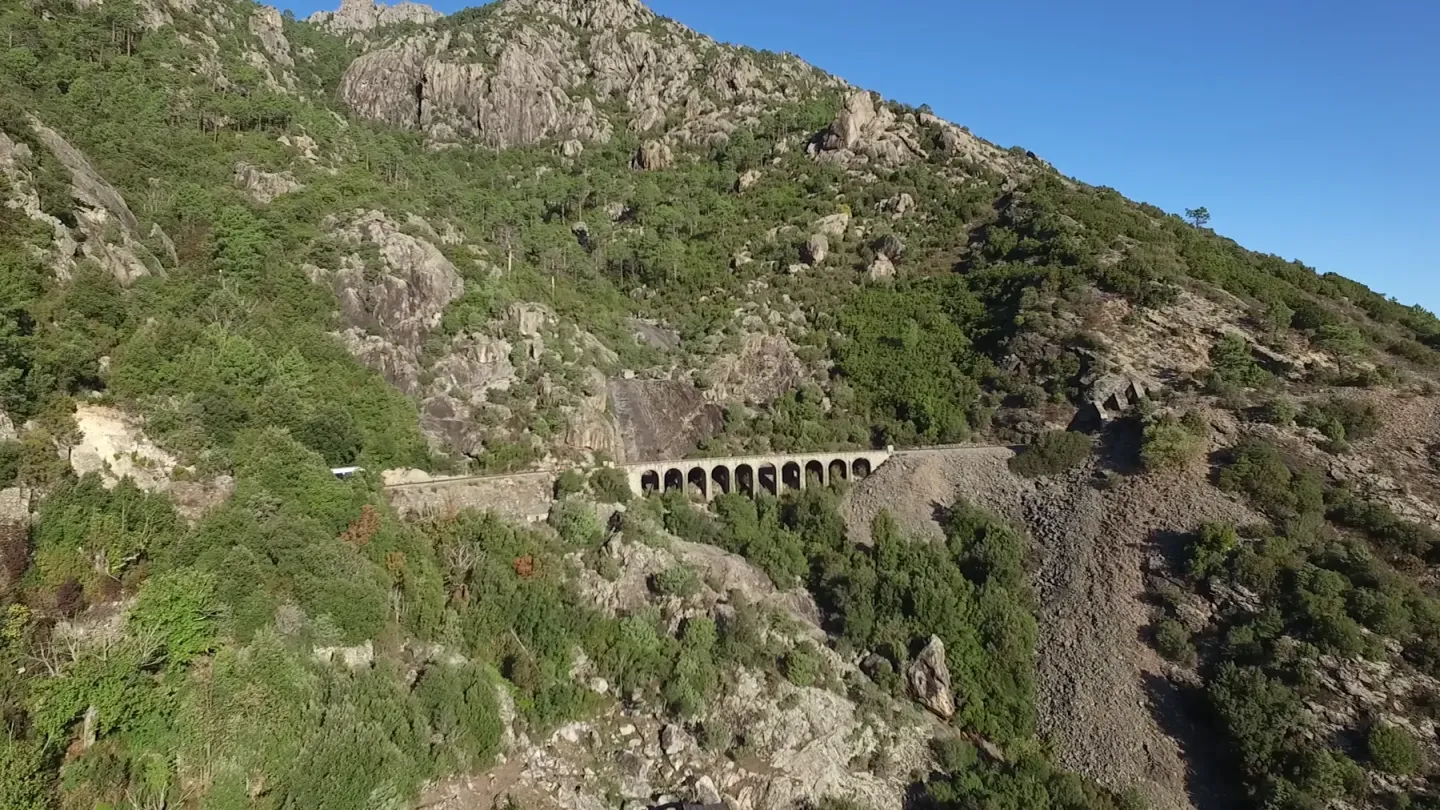
Guinguetta · still from the Train Corse film; an illustration of the network, not an event dated 2026
A documented account
This account draws on research involving the Corsican railways, the Collectivité de Corse, public archives and heritage institutions, as well as historical documents and photographic collections.
Contemporary photographs, undated documents and illustrations produced after the events described are identified in their captions.
The comparisons for 1869 and 1879 present proposed railway lines, not the network actually built. Where sources give conflicting dates or attributions, these differences are explained to distinguish established facts from information that remains uncertain.
Previous documentary verification: 8 October 2026.