
For the past week, a double train (UM2) has operated on the Bastia-Casamozza line during the morning peak between 7h30 and 8h30 to meet demand. Almost 800 people, including 600 secondary school students, use it each day to reach central Bastia in 20 minutes. This double-unit service was inaugurated on Tuesday morning in the presence of CFC railway officials, the territorial executive president and the mayors of the communes concerned (see reactions). It will soon be extended to all peak periods. Hyacinthe Vanni, chairman of Chemins de Fer de la Corse and vice-president of the Corsican Assembly, explains the changes to Net Infos.
 Secondary school students getting off at Montesoru.
- What was the purpose of this train journey?
- We wanted to demonstrate one of the new developments for the start of term. We have doubled peak-time capacity on the Casamozza-Bastia line, from 200 to 400 seats, with the comfort needed to carry passengers safely. The UM2, or two units coupled together, was full this morning. Between 7h30 and 8h30, we carry around 800 people, including 600 secondary school pupils. This keeps approximately 12 school coaches out of the city. The other passengers are travelling to work or public offices. We are delighted with this success. It is very important: the beginning of integrated transport.
- How was capacity doubled, and on which trains?
- We coupled two units together, doubling capacity on the train arriving at Bastia station at 7h50. We have been testing this multiple-unit operation for a week on this specific service, which runs at peak time for workers and students starting at 8 h. Demand is strong, and we have responded. All safety and reliability requirements are met. We are now confident that the trial is a success. We are preparing to introduce UM2 on the 17 h train, the afternoon peak service when schools finish.
- Are there more services?
- Yes. On Wednesdays, we have added services on this line and are considering doubling capacity with UM2 during the midday peak. We want to try multiple-unit operation at every peak period.
- This is a first step towards integrated transport. What else do you plan?
- The aim is to keep cars out of the city by encouraging drivers to leave them in the free interchange car parks we have built at Casamozza and Furiani, then take the train to Bastia. This has two benefits: reducing urban nuisance while increasing our revenue and developing the railway. The Furiani car park, already in use, will be inaugurated soon. It is very attractive.
- Are people beginning to get into the habit?
- Yes. Rail ridership is growing steadily. To give you an idea, 3 years ago the train carried 200 school students. Last year it carried 400; this year, 600. Given our capacity, we hope to increase that figure again next year. Demand certainly exists. It is up to us to provide a matching service and make people aware of it.
- Are double units planned for Ajaccio’s suburban services?
- Yes, that is planned. The priority around Ajaccio is to install CCVU, centralised single-track control, which will already allow us to double service frequency. We will also test UM2 to meet strong demand on Ajaccio’s suburban network, but until CCVU is installed we face technical constraints. I think everything will be installed by the end of 2019, allowing us to increase services.
- What comes next?
- Very soon, the Collectivité de Corse, which supports us, will inaugurate the platforms renovated to accommodate these multiple units. The Purettone platform will be completed at the end of the month. There are other strategic projects at Bastia, but it is for executive president Gilles Simeoni and executive councillor for transport Vanina Borromei to discuss them.
- Is a stop near the Palais de Justice, as proposed by Bastia’s mayor, feasible?
- Yes, we welcome it. I hope the Palais de Justice station project is completed, along with the passing facility between Bassanese and Furiani, which will allow us to increase services further and run them every quarter of an hour. There are other projects too, such as renewing rolling stock. These are led by the Collectivité de Corse and the transport authority. I know the executive is very attentive to the railway’s development.
Interview by Nicole MARI.
Elected representatives welcome the changes
 CFC chairman Hyacinthe Vanni with the mayors and deputy mayors of the four communes concerned and president Gilles Simeoni.
Gilles Simeoni, president of the Executive Council of the Collectivité de Corse : « The whole approach to serving Corsica’s major urban centres is changing. Today, these developments concern the greater Bastia area — Casamozza, Lucciana, Borgo, Biguglia, Furiani and Bastia — and the railway is progressing. The morning train carried 200 school students three years ago; today it carries 600. Doubling capacity should be seen alongside doubling frequencies, integrating transport modes and creating successive car parks to make central Bastia easier to reach. Tomorrow it will be the turn of the greater Ajaccio area. Things are taking shape. This is a profound change in our approach to transport, a strategic vision for more sustainable travel ».
Joseph Galetti, mayor of Lucciana : « The train is becoming popular again, and not before time, because it had fallen out of favour. Before the Second World War, it worked very well: the east coast stops connected with the villages, allowing everyone to travel to the main town. After decades of setbacks, station improvements and railway modernisation are making sense of it again. Today, everyone wants to take the train once more. An interchange will be developed at Casamozza. That is very important, because many people park wherever they can. We must provide the necessary convenience and, above all, encourage this way of thinking: ‘I arrive at Casamozza, take the train to Bastia, do what I need to do, return by train, collect my car and go back to my village.’ We need to reinforce that habit. That is what the railway is doing. I believe we are on the right track ».
Louis Pozzo Di Borgo, first deputy mayor of Furiani and vice-president of the CAB, the Bastia urban community: « Doubling the shuttle’s capacity is a major improvement. Many young people in our commune attend Montesoro secondary school and the Fango lycée. The train also helps ease congestion in Bastia, particularly with the new park-and-ride at Furiani station. From around 2020, with the CAB’s new PGD transport plan, we will try to direct vehicles heading into Bastia towards Furiani’s park-and-ride. This multimodal station should allow the train to take its rightful place ».
Pierre Savelli, mayor of Bastia : « Doubling capacity on some shuttles allows everyone to take the train at essential times. We are going from 200 to 400 students per shuttle, with nearly 800 students carried in the morning. We saw what that means at Montesoru. It is a real pleasure to see a full train carrying young people to school. Every young person taking the train means fewer vehicles on the roads, and fewer school buses too. We know what that represents in costs, road traffic and carbon impact. It is good news. We are on the right track. Much remains to be done to increase shuttle frequency and opportunities for trains to pass within Bastia. It is not only about train size: frequency also matters if we want to offer potential passengers more choice. We are moving forward, on the right track ».
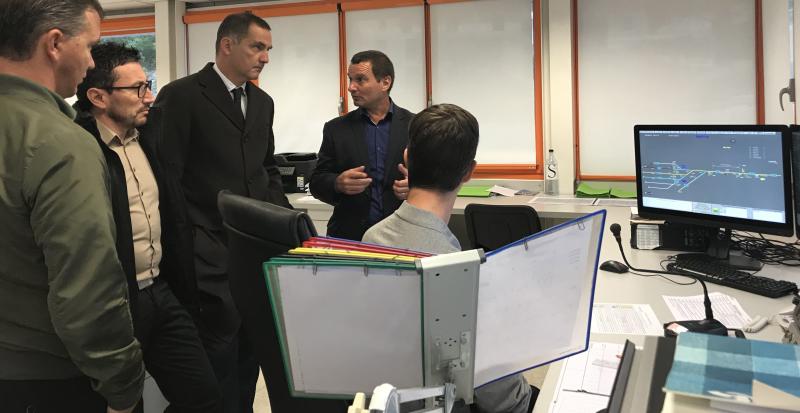
In the control room...
Report and photographs Corse Net Infos