
Hyacinthe Vanni, a territorial councillor from the Femu a Corsica group, was elected chairman of Chemins de Fer de la Corse (CFC) on Tuesday afternoon at the first board meeting of the new term. An ally of regional executive president Gilles Simeoni, he knows the railway company well, having sat on its board since its creation in 2011. At that time, he stood for the same position as the nationalist opposition’s candidate, and Communist Michel Stefani needed three rounds of voting to win. Now the sole candidate, he was elected in the first round with ten votes in favour and seven blank ballots. Territorial councillor Petr’Anto Tomasi, chairman of the Corsica Libera group, was elected vice-chairman. Hyacinthe Vanni gives Corse Net Infos his immediate reaction and sets out a programme based on transparency and fairness. His aim is to make the railway network ‘a major tool for Corsica’s development’.
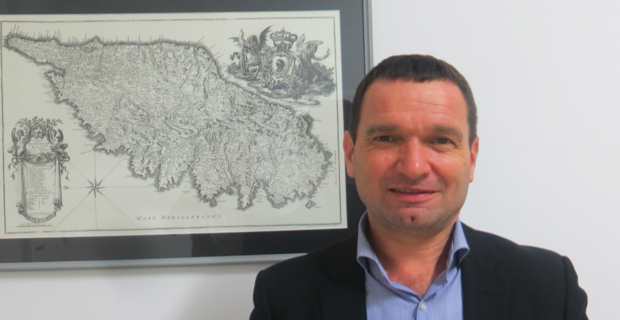
Hyacinthe Vanni, Femu a Corsica territorial councillor in the Corsican Assembly and newly elected chairman of Chemins de Fer de la Corse (CFC).
Why did you accept the chairmanship of CFC after declining to join the territorial executive?
I did not refuse to join the executive; I simply believe you should work where you feel most useful. Today, I think that is in the Corsican Assembly and at Chemins de Fer de la Corse. I have sat on the CFC board since the SAEM, the mixed-economy company, was created four years ago. I know the company well and believe I have done good work there. I am very happy and proud to become its chairman and to continue working to make this major tool for Corsica’s development fully effective.
You know it well. What condition is it in?
It is in a satisfactory condition. I would like to acknowledge the work of my predecessor, Michel Stefani, during his chairmanship. Much has been done, although much clearly remains to do. CFC has had labour problems and tensions with the unions. What matters now is implementing the programme drawn up by the new Executive Council of the CTC, the territorial authority of Corsica.
What programme?
The programme everyone knows, presented during the election campaign and now shared by the whole territorial majority: a new method of governance based on transparency, fairness and dialogue with staff. These three priorities will guide my actions, and I will make a point of honour of upholding them. I will start immediately. Over the coming days, I will meet all staff and the 270 railway workers individually. Every railway worker deserves to be heard. I will speak with each one, so they can tell me what is working and what is not. This matters a great deal to me. I will invite staff to regular meetings and always be available to anyone who wants to talk. My door will always be open. That is what dialogue with staff means to me.
You also have a reputation for being very demanding. Do you accept that?
Yes! I apply that discipline to myself first. Rather than discipline, I prefer to speak of fairness. I am very demanding of myself, and I will be equally demanding of my colleagues, the director and department heads. I expect results. I am here to ensure that every railway worker’s rights are respected, but also that passengers receive a genuine public service. I will be uncompromising in carrying out the programme set by the president of the Executive Council.
Should we therefore expect major changes?
There will be continuity, but also change. Reorganisation is necessary. Some things need correcting and adjusting, and some behaviour needs improving. I will discuss this first with staff representatives and department heads.
You mention fairness. In which areas?
Recruitment in particular. We will introduce competitive selection and recruitment panels. Vacancies will not be reserved for particular people. Everyone will be able to apply and have a chance. For us nationalists, this is fundamental, and we will introduce it everywhere. I fully support the executive president’s policy of a ‘glass house’. Everything must be transparent: CFC, the agencies and offices, and everything we are called upon to manage.
As with the offices and agencies, have you found debts at CFC? Will you commission an audit?
No, there is no debt. I do not think an audit is needed. As far as we know, there has been neither financial misconduct nor mismanagement; quite the contrary. The SAEM budget is simple: around five million € a year in its own revenue and more than 20 million € a year in CTC funding. As elsewhere, we will watch operating expenditure very closely.
CFC depends on territorial funding. How can that change?
Five million euros in revenue is little, but also a lot compared with where we started. Not so long ago, revenue was only three million €; it is growing. Every additional euro of revenue brings a proportionate reduction in territorial funding. In the current climate, a smaller CTC contribution is clearly better for the authority. Under present conditions, however, breaking even is impossible, and it is not our aim today. Corsica deserves a genuine public service. Our objective is to make this resource as effective as possible and provide a high-quality public service. At the same time, I will work to increase revenue.
How?
To find additional revenue, we need to develop sectors such as freight, which is currently at zero. Starting from nothing is not easy. The lack of suitable equipment is a handicap. We have just received shunting locomotives bought during the previous term. Unfortunately, they are not at all what we expected: second-hand equipment more than 40 years old. We need a precise assessment of what they can do and how best to use them. Whatever the outcome, we are determined to increase freight. There is considerable scope, whether for waste or goods transported across the island.
Is transporting waste by train a realistic option?
Yes, absolutely. Take the Tragone waste facility, next to the station. Sorted waste from Ponte-Leccia or Calvi could easily be brought to this ultra-modern facility by train instead of by lorry, as it is today. Goods could be transported in the same way. Everything remains to be done. We will then need to consider opening other routes on the eastern plain, initially towards Folelli. The CTC commissioned a study during the previous term.
The line to Folelli has been discussed for years. What does the study say?
It has never been shared with us. Now that we are in office, we can examine it, see whether the extension is viable and carry out an impact study. Land ownership presents no problems as far as Folelli, so why not consider it quickly? I am convinced this is the future: both a potentially significant source of revenue and a way to develop the railway network. We also need an overall review, including better coordinated timetables suited to workers and students travelling to university in Corte. Journey times between Bastia and Ajaccio also need reducing to make the train more attractive, which it is not really on that route today.
How do you intend to reduce journey times?
By introducing CCVU, centralised single-track control. This automated system primarily improves safety, because it can correct human error. By allowing trains to pass one another, it also improves comfort and frequency and reduces journey times, if only by cutting waiting time. A concrete example: Ile Rousse and Ponte-Leccia are 50 kilometres apart. Trains cannot pass each other, so one must arrive at Ponte-Leccia or Ile Rousse before another can be sent. With CCVU, trains will be able to pass at Palasca, increasing frequency and avoiding waits and long journeys. The system is already in place between Bastia and Casamozza. Our aim is to extend it across the network. This is a major investment eligible for the PEI, the exceptional investment programme. Before the end of the year, the CTC will issue a tender to implement it gradually.
One of Gilles Simeoni’s major projects as mayor of Bastia was integration between car and train travel. Is that still on the agenda?
Absolutely. It is part of the programme set by the president of the Executive Council. A great deal of work is needed on interchange and multimodal stations, particularly in suburban areas. These are medium-term projects for which we will commission studies, but we intend to move as quickly as possible. The train must both ease congestion in city centres, particularly Bastia, Ajaccio and Calvi, and improve access to the island’s interior through more frequent services between Corte and Bastia and between Corte and Ajaccio. More and more people live in rural areas and villages and need to travel into town for work. The train must serve as public transport.
Is this a new turning point for the railway?
I hope so. We have solemnly pledged to work for the collective interests of Corsica and the Corsican people. But we cannot build a modern, prosperous country without genuine strategic infrastructure. The railway is essential, not only to provide Corsicans with the public service they deserve, but also to develop the whole territory and combat depopulation in the interior. In that sense, yes: it is a turning point, a new path opening up.
Interview by Nicole MARI for corsenetinfos.corsica